
TL;DR

Prime made for students and young adults
- Fast, free delivery for dorm and study essentials
- Prime Video and Amazon Music included
- Member-only deals
Educational science kits for kids work best when matched to age (sensory play at 3–5, guided experiments at 6–8, independent work at 9+) and to a specific interest like chemistry, circuits, or robotics. Snap Circuits is a market leader in electronics kits, and safety comes down to checking for ASTM F963 compliance and honest supervision expectations. Subscription boxes run $20–40/month and suit curious tinkerers, while one-time kits under $30 often deliver better value for a single interest.
The baking soda volcano has launched approximately one million future scientists. It’s messy, it fizzes, and it teaches more in ninety seconds than a worksheet does in a week. That’s the quiet power of a good science kit: kids don’t memorize — they watch cause meet effect in real time.
But walk down the toy aisle (or scroll Amazon) and you’ll find hundreds of options, from $12 crystal-growing sets to $200 robotics platforms. Some are brilliant. Some are glittery landfill. The difference matters.
In this guide, you’ll learn how to match a kit to your child’s age and interests, which safety certifications to look for, whether STEM subscription boxes are worth the monthly fee, and how to keep a kid engaged after the first experiment ends. Let’s dig in.
Match the kit to age: sensory play for 3–5, adult-guided experiments for 6–8, independent kits for 9–12, and real reagent/coding kits for teens.
Always check for ASTM F963 (and CE) markings plus CPSIA-compliant, non-toxic materials — and respect the 10+/12+ rating on genuine chemistry sets.
Snap Circuits is a market leader in electronics kits because open-ended systems with many projects beat single-experiment kits for long-term engagement.
Subscription boxes ($20–40/month, e.g., Kiwico, Mel Science, CrunchLabs) suit kids with broad curiosity; one-time kits suit kids with one deep interest.
Many excellent kits cost under $25–30 — engagement depends more on follow-up (lab notebooks, redoing failures) than on price.
Why Hands-On Science Beats Watching Videos (And What Research Says)
Hands-on learning improves retention compared to passive instruction — kids remember what they do, not what they watch. When your child mixes, drops, builds, and (yes) fails, their brain treats the outcome as a real event worth remembering, not just content to scroll past.
Think about it this way: a YouTube video about circuits is a movie. A Snap Circuits board on the kitchen table is a rehearsal. The child who presses a snap-on switch and watches a fan spin has formed a cause-and-effect memory that no screen replicates.
There are three deeper payoffs, according to research on early STEM exposure from organizations like the NSF and AAUW:
- Scientific method thinking — hypothesis, observation, recording what happened, trying again
- Failure tolerance — a flopped experiment teaches iteration, not shame
- Early STEM interest — exposure at ages 5–10 correlates with sustained interest later, helping counter the well-documented “leaky pipeline” into STEM careers
A kid who learns that a failed slime batch is data — not a disaster — has learned the single most important lesson in science.
The fine motor skills and patience required to follow multi-step instructions? Those come along for free. Building a marble run is occupational therapy disguised as a Saturday afternoon.
Match the Kit to the Age: A Simple Chart That Saves You Money
Educational science kits are age-graded for safety and cognitive fit, and buying above your child’s age bracket is the #1 reason kits get abandoned. A brilliant robotics kit in the hands of a 6-year-old becomes a parent’s homework assignment by day two. Here’s the honest breakdown:
| Age | What Works | Real Examples |
|---|---|---|
| 3–5 years | Sensory play, oversized parts, simple cause-and-effect | Butterfly gardens, big-piece magnet sets, color-mixing kits |
| 6–8 years | Guided experiments with adult help | Baking soda volcanoes, crystal growing, Botley the coding robot |
| 9–12 years | Independent exploration, real (safe) lab equipment | Snap Circuits Pro, LEGO Boost, beginner microscope sets |
| Teens | Advanced chemistry, real coding projects | Arduino, Raspberry Pi, genuine reagent chemistry sets (12+) |
Notice the supervision gap: the 6–8 bracket is where most frustration lives. These kits are designed for a parent nearby, reading steps aloud and managing the mess. Buy them assuming you’ll participate, and they’re fantastic. Buy them expecting self-entertainment, and they’ll gather dust by Thursday.
The 6 Types of Kits (And Which Kid Each One Suits)
There are six main types of kits, and picking the right discipline matters more than picking the right brand. The kid who loves watching ants carry crumbs will ignore a circuit board — and vice versa. Think of it like shoes: the best-running-shoe-in-the-world is useless if you need hiking boots. Match the kit to the obsession:
- Chemistry sets — slime, crystals, color-changing reactions. Perfect for the kid who asks “what happens if I mix these?” Picture the 8-year-old who poured shampoo into the toilet “to see what would happen” — that kid needs an outlet, safely. A National Geographic crystal-growing kit gives that same impulse a home: mix the solution, watch purple crystals bloom on a rock over a week, and the “what if” energy gets channeled instead of confiscated.
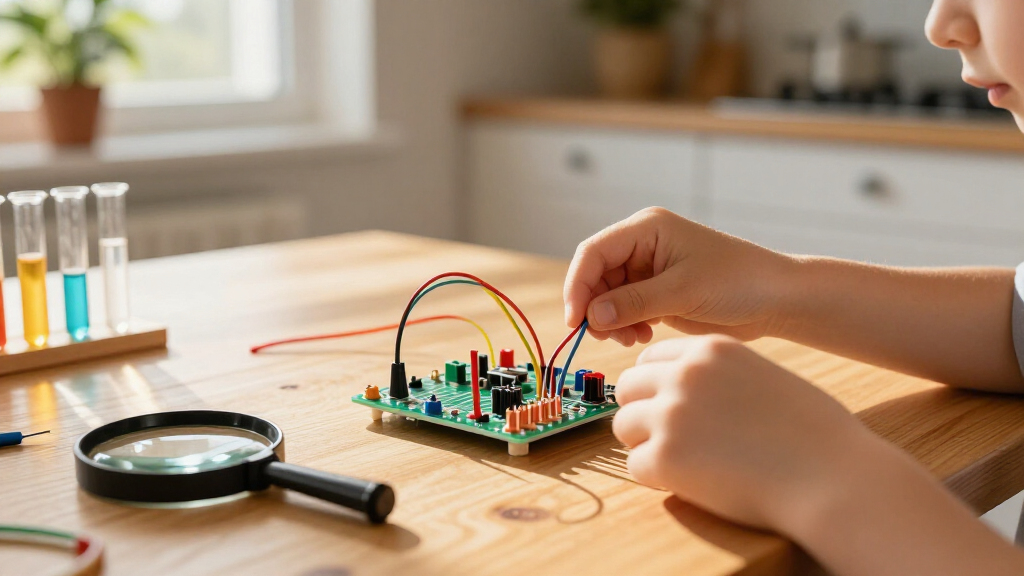
- Electronics — Snap Circuits is a market leader here for good reason: color-coded pieces snap together like LEGO, no soldering, no burns. It’s like giving your kid a light-switch panel instead of a wiring diagram — the abstract becomes tactile. One Saturday, a 9-year-old builds a working doorbell and rings it forty times; the next weekend, a flying saucer launcher — same board, new manual page. Best for builders age 8+.
- Robotics & coding — LEGO Boost and SPIKE, Sphero, Botley. These pair with block-based coding (like Scratch) and suit kids who already like screens — but want to control something real. Imagine the kid who’d rather program Sphero to roll through a hallway obstacle course made of shoes — timing each run, adjusting the speed, cheering when it finally dodges every sneaker — than watch another video. That’s coding motivation in the wild.
- Life science — microscopes, ant farms, butterfly gardens. For the bug-catcher and leaf-collector. Low mess, high patience required. Concrete example: a $40 beginner microscope turns an onion skin into a wow moment — the kid peels the thinnest layer she can manage, drops it on a slide, and suddenly sees brick-like plant cells, visible, on your kitchen table. Or the Insect Lore butterfly garden: five caterpillars arrive by mail, and two weeks later the whole family gathers to release five Painted Lady butterflies in the backyard.
- Earth science — rock and mineral collections, weather stations, dinosaur dig kits. Great for younger kids since “excavating” a plastic T-rex from a sand block is basically sanctioned digging — a 5-year-old will chip away with the wooden brush for a solid hour, paleontologist-style. A tumbled-rock collection works like a gateway drug to geology: the kid who thought “rocks are boring” discovers that one of them is actually volcanic.
- Physics & engineering — magnet kits, marble runs, simple machines. Open-ended and replayable — the best value-per-dollar category. Think of a magnet set as a 50-experiment kit wearing a 5-experiment label: fridge, paperclips, cereal (crush it, hover a magnet, watch the iron filings cling — an actual “whoa” moment), magnetic levitation, homemade compasses. A marble run is LEGO-meets-physics: the first build follows instructions, the tenth build is pure Rube Goldberg invention.
One honest caveat: many kits blur categories now. A “green science” kit might combine weather, chemistry, and recycled-material engineering — say, building a windmill from soda bottles that actually powers a small LED. That’s fine. Just make sure the core activity is something your specific kid has already shown interest in. If they’ve never once asked about bugs, the ant farm is your project, not theirs.
Subscription Box or One-Time Kit? The Honest Math
STEM subscription boxes cost roughly $20–40 per month and deliver a fresh project every month — Kiwico, Mel Science, Little Passports, and Mark Rober’s CrunchLabs are the big names. One-time kits run $15–60 once. Which wins depends entirely on your kid’s temperament.
Subscriptions shine for the kid who finishes a project and immediately asks “what’s next?” Kiwico’s Tinker and Maker lines, in particular, have earned a loyal following since the pandemic-era homeschooling boom pushed monthly boxes into the mainstream. CrunchLabs’ build-and-hack boxes lean older and more engineering-minded.
But subscriptions quietly fail for a different kid: the one with one burning interest. If your daughter is obsessed with crystals, six months of mixed-topic boxes won’t beat a single great crystal-growing kit plus a book.
| Factor | Subscription Box | One-Time Kit |
|---|---|---|
| Monthly cost | $20–40 | $0 after purchase |
| Novelty | High — new project monthly | Fades after completion |
| Best for | Broad curiosity, gift that keeps arriving | Deep single interest |
| Replay value | Low per box | High if open-ended (Snap Circuits, marble runs) |
Buy open-ended kits, not single-experiment kits. A Snap Circuits set with 100 projects beats a volcano kit with one eruption — every time.
Safety Check: The 3 Marks That Matter on the Box
Modern science kits are dramatically safer than the vintage chemistry sets your parents grew up with — the genuinely hazardous reagents are long gone. But you should still check the box for three things before buying anything, especially for younger kids.
- ASTM F963 — the U.S. toy safety standard. If it’s not printed on the packaging, put it back.
- CE marking — the European equivalent; a second independent set of eyes.
- CPSIA-compliant, non-toxic materials — non-negotiable for anything a child under 6 might touch or (let’s be honest) lick.
Two practical rules on top of that: heed small-parts warnings if a toddler lives in the house, and respect the age floor on real chemistry sets. Kits with genuine reagents are rated 10+ or 12+ for a reason — the reactions are mild, but they’re real, and they deserve real supervision.
A quick illustration: my neighbor bought a “junior chemist” kit for her 7-year-old, saw the 10+ label at home, and panicked. The fix was easy — they did the experiments together, with her handling the measuring. Supervision converted a “return it” into a spring of Saturday-morning experiments.
5 Ways to Keep the Magic Alive After Week One
Most kits die not because they’re bad, but because the first experiment ends and nobody knows what to do next. Engagement is a skill you can engineer, and these five habits make the difference between a one-week toy and a year-long hobby.
- Buy expandable systems — Snap Circuits, LEGO robotics, and marble-run sets all support add-on packs that grow with the kid. The family that starts with a basic Snap Circuits set can add a solar-power module next birthday and a motion-detector pack the one after — the gift pipeline solves itself.
- Keep a lab notebook — even a $2 spiral pad. One kid I know titled hers “Experiments & Explosions (Small Ones)” and filled it with predictions, drawings, and results. Recording what happened turns play into genuine scientific practice — and becomes a keepsake by summer’s end.
- Let them redo failed experiments — “what would you change?” is the best question in science parenting. When the first crystal-growing attempt produces murky sludge instead of geodes, that’s not a failure — it’s a variable to test. More powder? Colder windowsill? Longer wait? That redo is where real science lives.
- Connect kits to the real world — after the weather station, watch an actual forecast together and compare: did your backyard anemometer agree with the TV meteorologist about yesterday’s wind? After the butterfly garden, visit a nature center and spot the species you raised.
- Rotate, don’t saturate — one kit on the shelf at a time beats five competing for attention. A kit pulled back out after two months in the closet plays like a brand-new toy.
Budget note: you don’t need to spend big. Plenty of excellent kits sit under $25–30, and honestly, a box of baking soda, vinegar, food coloring, and dish soap is the greatest $6 science kit ever assembled.
Frequently Asked Questions
What age should kids start with science kits?
As early as age 3, with sensory kits built around oversized parts and simple cause-and-effect — think color-mixing and big-piece magnet sets. Structured experiments with adult help suit ages 6–8, and independent exploration with real lab equipment works from about 9. Genuine reagent chemistry sets are typically rated 10+ or 12+.
Are chemistry sets safe for kids?
Yes — modern chemistry sets are far safer than vintage ones, which contained genuinely hazardous chemicals. Today’s kits use mild, non-toxic reagents (the classic baking soda volcano lives on for a reason). Still, check for ASTM F963 compliance, follow the age rating, and supervise any set with real chemical reactions.
Are STEM subscription boxes worth the money?
At $20–40/month, they’re worth it for kids with broad, ongoing curiosity — a fresh project every month prevents boredom. Popular options include Kiwico, Mel Science, Little Passports, and Mark Rober’s CrunchLabs. If your child has one deep interest (like crystals or circuits), a single high-quality open-ended kit usually delivers better value.
What’s the difference between STEM and STEAM kits?
The “A” adds arts. STEM kits focus on science, technology, engineering, and math; STEAM kits incorporate creative design — building a decorated kaleidoscope rather than just assembling a lens rig. Both teach the same core thinking; STEAM kits often suit kids who lean creative and might resist a “pure science” box.
Do science kits actually improve school performance, or are they just toys?
Research on hands-on learning shows better retention than passive instruction, and early STEM exposure correlates with sustained interest in science later in school. They won’t replace a curriculum, but they build real skills: following procedures, recording observations, and — most importantly — treating failure as data rather than defeat.
Conclusion
Here’s the one thing to remember: the best science kit is the one matched to your kid’s age and their actual obsession — not the one with the most experiments listed on the box. A $25 magnet set for a magnet-obsessed 7-year-old beats a $150 robotics platform she’s not ready for, every single time.
Somewhere out there is a kid who’ll fizzle a volcano this weekend and spend the next twenty years chasing that feeling. Your job is just to hand them the vinegar.
Fall Picks
fall essentials
As an affiliate, we earn on qualifying purchases.