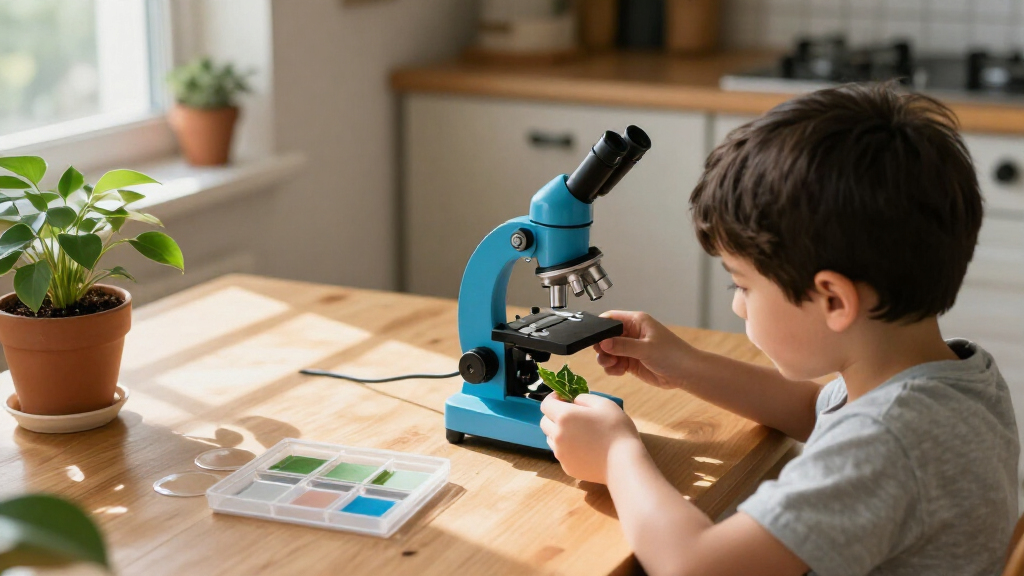

The best microscope kits for kids pair a view children can focus with a setup they can manage themselves. My best overall pick is the National Geographic Dual LED Microscope Science Kit for its straightforward learning focus and flexible lighting; the TOMLOV DM301K stands out for kids who prefer a digital screen, while the AmScope M30-ABS-KT2-W suits families seeking a more traditional compound microscope. The main tradeoff is between hands-on optical viewing and the convenience of a screen, with included slides and accessories also affecting how quickly kids can start. Magnification claims alone do not tell you how easy a kit is to focus or use. Read on for the full breakdown and help matching a kit to your child’s age, patience, and interests.

Prime made for students and young adults
- Fast, free delivery for dorm and study essentials
- Prime Video and Amazon Music included
- Member-only deals
Key Takeaways
- The National Geographic Dual LED kit earns the overall spot by balancing a child-friendly science-kit approach with two lighting options, rather than relying on magnification claims alone.
- Digital models such as the TOMLOV DM301K, BEBANG PM1000, BMDSAE, and HEWEIMEI trade direct eyepiece viewing for a screen that can make group viewing easier; screen size and portability separate them.
- Traditional compound microscopes, including the AmScope M30-ABS-KT2-W and PalliPartners model, are better suited to children ready to learn focusing and slide placement than to kids who want instant results.
- The Mileonaim, Uarzt, Novaluki, and Xelabrion kits emphasize slides or accessory counts, but a larger kit is only useful when its contents support activities the child will actually try.
- The National Geographic Junior kit’s lower stated magnification range points toward simpler exploration, while higher advertised ranges on several other kits should not outweigh ease of focusing, lighting, and stability.
| PalliPartners Compound Microscope for Adults and Students |  | Best for Growing Into More Advanced Exploration | Magnification: 100X–2000X | Objective lenses: 4X, 10X, and 40X | Eyepiece: WF25X | VIEW LATEST PRICE | See Our Full Breakdown |
| BEBANG PM1000 Kids Digital Microscope Kit |  | Best Portable Digital Pick | Magnification: 200x–1000x across five levels | Storage: 32GB memory card | Included slides: 5 prepared glass specimens | VIEW LATEST PRICE | See Our Full Breakdown |
| National Geographic Dual LED Microscope Science Kit for Kids, Ages 8–12 |  | Best for Exploring Slides and Solid Objects | Magnification: 20x and 50x | Illumination: Dual LED | Prepared slides: 10 | VIEW LATEST PRICE | See Our Full Breakdown |
| National Geographic Kids Microscope Kit, Up to 400x Magnification |  | Best for Younger First-Time Microscopists | Maximum magnification: 400x | Magnification levels: 3 | Lighting: LED above and below | VIEW LATEST PRICE | See Our Full Breakdown |
| TOMLOV DM301K Kids Microscope Science Kit |  | Best for Cordless Beginner Sessions | Model: DM301K | Recommended age: 6–12 years | Lighting: Top and bottom LED lights | VIEW LATEST PRICE | See Our Full Breakdown |
| BMDSAE 1000x Handheld Digital Microscope for Kids with 2.0-Inch IPS Screen |  | Best Compact Digital Pick | Magnification: Up to 1000x | Display: 2.0-inch IPS screen | Camera: 2MP | VIEW LATEST PRICE | See Our Full Breakdown |
| HEWEIMEI 1600x Digital Microscope for Kids with 4-Inch Screen |  | Best Large-Screen Digital Pick | Magnification: 100x–1600x | Screen: 4-inch IPS | Camera: 48MP; 1080p video | VIEW LATEST PRICE | See Our Full Breakdown |
| Mileonaim Kids Microscope Kit with Prepared and Blank Slides |  | Best for Slide-Making Activities | Magnification: 100X, 400X, and 1200X | Piece count: 61 | Prepared slides: 12 | VIEW LATEST PRICE | See Our Full Breakdown |
| Novaluki 65-Piece Kids Microscope Kit, 100x–1200x |  | Best for Collecting Specimens | Magnification: 100x, 600x, and 1200x | Kit contents: 65 pieces | Slides: 12 prepared specimens and 45 blank slides | VIEW LATEST PRICE | See Our Full Breakdown |
| AmScope M30-ABS-KT2-W Beginner Compound Microscope STEM Kit, White |  | Best Traditional Compound Microscope Kit | Microscope type: Compound | Viewing head: Monocular | Magnification: 300x, 600x, and 1200x | VIEW LATEST PRICE | See Our Full Breakdown |
| Uarzt 58-Piece Kids Microscope Kit with Carrying Case |  | Best for Organized First Experiments | Pieces: 58 | Prepared slides: 13 | Blank slides: 31 | VIEW LATEST PRICE | See Our Full Breakdown |
| HKMK Compound Microscope for Adults and Kids, 40x–2000x, with Experiment Kit and Phone Adapter |  | Best for Older Kids Ready for More Control | Magnification: 40×–2000× | Objective lenses: 4×, 10×, and 40× achromatic | Eyepieces: WF10× and WF25× | VIEW LATEST PRICE | See Our Full Breakdown |
| Uarzt Kids Beginner Microscope Science Kit with LED Light and Slides |  | Best for Guided Slide-Making | Model: RM | Magnification: 100×, 400×, and 1200× | Objective lens: Achromatic | VIEW LATEST PRICE | See Our Full Breakdown |
| National Geographic Junior Microscope Science Kit, 50x–250x Magnification |  | Best for Youngest Beginners | Magnification: 50×–250× | Lighting: LED lights above and below | Prepared slides: 6 | VIEW LATEST PRICE | See Our Full Breakdown |
| Xelabrion Kids Microscope Science Kit, 67 Pieces, 100X–1200X |  | Best for Outdoor Specimen Collection | Pieces: 67 | Magnification: 100×–1200× | Prepared slides: 12 | VIEW LATEST PRICE | See Our Full Breakdown |
| microscope kits for kid | Magnification | Lighting |
|---|---|---|
| PalliPartners Compound Microsc | 100X–2000X | — |
| BEBANG PM1000 Kids Digital Mic | 200x–1000x across five levels | — |
| National Geographic Dual LED M | 20x and 50x | — |
| National Geographic Kids Micro | — | LED above and below |
| TOMLOV DM301K Kids Microscope | — | Top and bottom LED lights |
| BMDSAE 1000x Handheld Digital | Up to 1000x | 8 adjustable LEDs with 3 brightness settings |
| HEWEIMEI 1600x Digital Microsc | 100x–1600x | 6 LED lights with 3 brightness modes |
| Mileonaim Kids Microscope Kit | 100X, 400X, and 1200X | — |
| Novaluki 65-Piece Kids Microsc | 100x, 600x, and 1200x | — |
| AmScope M30-ABS-KT2-W Beginner | 300x, 600x, and 1200x | — |
| Uarzt 58-Piece Kids Microscope | — | LED |
| HKMK Compound Microscope for A | 40×–2000× | Battery-powered LED and reflector |
| Uarzt Kids Beginner Microscope | 100×, 400×, and 1200× | Adjustable LED |
| National Geographic Junior Mic | 50×–250× | LED lights above and below |
| Xelabrion Kids Microscope Scie | 100×–1200× | Seven-color LED |
More Details on Our Top Picks
PalliPartners Compound Microscope for Adults and Students
For families ready to move beyond low-power inspection of rocks and larger objects, the PalliPartners Compound Microscope offers the widest stated magnification range in this group: 100X–2000X. Its glass optics, three objectives, and coaxial coarse and fine focus controls make it a more hands-on choice than the simpler National Geographic Kids Microscope Kit, which tops out at 400X. The adjustable upper and lower LEDs also let kids examine both opaque objects and prepared slides, while 10 prepared and 18 blank slides provide room to practice. A phone adapter and Bluetooth shutter add a way to share images, but they do not make this a digital-screen microscope. The tradeoff is a more involved setup suited to supervised experiments, not the easiest pick for a young child’s first independent use.
Pros:- Glass optics and three objectives offer a broad range for slide-based exploration.
- Adjustable top and bottom LEDs accommodate opaque objects and translucent specimens.
- Includes 10 prepared slides and 18 blank slides for practice and new samples.
- Coaxial coarse and fine focus controls support more controlled focusing.
Cons:- Adult supervision is recommended, making it less suited to independent use by young children.
- The phone accessories support image capture but do not provide a built-in viewing screen.
Best for: Families with older children who want a traditional compound microscope, a broad magnification range, and enough blank slides for repeated experiments.
Not ideal for: Younger beginners who need a simple, self-guided introduction or a built-in screen for viewing together.
- Magnification:100X–2000X
- Objective lenses:4X, 10X, and 40X
- Eyepiece:WF25X
- Additional lens:2X
- Illumination:Adjustable top and bottom LED
- Focus:Coaxial coarse and fine focus knobs
- Included slides:10 prepared and 18 blank
- Included accessories:Phone clip adapter, Bluetooth camera shutter, and power adapter
Our verdict“Choose the PalliPartners for supervised, slide-focused exploration with room to advance, rather than the simpler 400X National Geographic kit for a first microscope.”
BEBANG PM1000 Kids Digital Microscope Kit
The BEBANG PM1000 is the portability pick for kids who want to save images and take a microscope outside the usual desk setup. It weighs 0.34 pounds, recharges by USB-C, and includes a fitted EVA case and neck strap; its 32GB memory card also gives children a place to keep photos and videos. That makes it a different kind of kit from the optical National Geographic Dual LED Microscope Science Kit, which emphasizes hands-on slide preparation and viewing rather than digital records. Five magnification levels from 200x to 1000x offer flexibility for close inspection, but the five included prepared slides leave less room to start experimenting than the PalliPartners kit’s 28 slides. Its battery lasts about 2.5 hours, so longer outings call for a charging plan.
Pros:- Lightweight body, neck strap, and EVA case make it easy to carry.
- 32GB memory card supports saving photos and videos.
- USB-C charging avoids disposable batteries.
- Five magnification levels provide several viewing options.
Cons:- Approximately 2.5 hours of battery life can limit extended sessions.
- Includes only five prepared slides, fewer than the PalliPartners kit’s prepared-and-blank assortment.
Best for: Kids who want a lightweight digital microscope for short outdoor explorations and saving images or videos.
Not ideal for: Families seeking a traditional eyepiece microscope, a large starter slide collection, or long sessions away from charging.
- Magnification:200x–1000x across five levels
- Storage:32GB memory card
- Included slides:5 prepared glass specimens
- Battery life:Approximately 2.5 hours
- Charging:USB-C
- Weight:0.34 lb
- Included case:EVA carrying case
- Warranty:1 year
Our verdict“Pick the BEBANG for portable digital documentation, but choose the National Geographic dual-LED kit if hands-on slide work matters more than saving images.”
National Geographic Dual LED Microscope Science Kit for Kids, Ages 8–12
Among these kits, the National Geographic Dual LED Microscope Science Kit makes the clearest case for varied, guided discovery: lower illumination helps with slides, while upper illumination is designed for three-dimensional objects. Its 20x and 50x glass lenses are modest beside the 400x National Geographic Kids kit or the higher-range PalliPartners, but that lower-power approach suits children who want to examine a geode, a leaf, and prepared samples without focusing only on tiny slide details. The 50-plus-piece set includes prepared and blank slides, specimen tools, and a learning guide, giving kids activities to follow as well as materials to handle. The tradeoff is limited magnification for fine-detail viewing, so it is a better introduction to broad observation than a choice for ambitious slide microscopy.
Pros:- Upper and lower LED lighting supports solid objects as well as slides.
- Includes 10 prepared and 10 blank slides for guided and original observations.
- Geode, specimen tools, and learning guide encourage varied activities.
- Padded storage container helps keep the kit together between sessions.
Cons:- 20x and 50x magnification is limited compared with the 400x National Geographic Kids kit.
- Less suited to children whose main goal is fine-detail examination of prepared slides.
Best for: Children ages 8–12 who want guided activities and the flexibility to view both slides and larger solid specimens.
Not ideal for: Kids focused on high magnification or families seeking a microscope for detailed, fine-scale slide study.
- Magnification:20x and 50x
- Illumination:Dual LED
- Prepared slides:10
- Blank slides:10
- Included accessories:50+ pieces
- Recommended age:8–12 years
- Warranty:1 year against manufacturer defects
Our verdict“Choose this National Geographic kit for varied, guide-led exploration of slides and larger objects, not for high-magnification work.”
National Geographic Kids Microscope Kit, Up to 400x Magnification
For a child’s first microscope, the National Geographic Kids Microscope Kit balances a useful 400x ceiling with approachable controls and a ready-to-use mix of specimens. Large focus knobs, a soft-touch eyepiece, and an adjustable platform can make early sessions less fiddly than the more advanced PalliPartners compound microscope. Upper and lower LEDs add flexibility: children can inspect rocks and minerals as well as prepared plant slides. The six prepared slides, six blank slides, specimen tools, and illustrated lab guide provide a practical starting point, though the slide selection is smaller than the National Geographic Dual LED Microscope Science Kit’s 20-slide set. Its plastic enclosure and battery power are tradeoffs for a lightweight, child-oriented design; families should plan to supply batteries.
Pros:- Three magnification levels reach up to 400x for varied beginner observations.
- Upper and lower LEDs support viewing slides and solid objects.
- Large focus knobs and a soft-touch eyepiece suit younger users.
- Includes plant slides, rocks and minerals, blank slides, tools, and an activity guide.
Cons:- Plastic enclosure may feel less durable than a metal-bodied microscope.
- Battery-powered operation requires batteries and lacks the convenience of a rechargeable kit.
- Six prepared slides provide a smaller starting collection than the dual-LED National Geographic kit.
Best for: Families introducing children ages 6 and up to microscope activities who want simple controls and a mix of slides and solid specimens.
Not ideal for: Buyers seeking a metal-bodied instrument, rechargeable power, or a large slide collection for repeated experiments.
- Maximum magnification:400x
- Magnification levels:3
- Lighting:LED above and below
- Power source:Battery powered
- Objective lens:Achromatic
- Dimensions:11 × 6.7 × 12 inches
- Weight:1.8 pounds
- Included items:6 prepared plant slides, 6 rocks and minerals, 6 blank slides, pipette, specimen dish, tweezers, and lab guide
- Recommended age:6+
Our verdict“This is a practical first microscope for younger children who value easy controls and mixed specimens over a larger slide set or advanced optics.”
TOMLOV DM301K Kids Microscope Science Kit
The TOMLOV DM301K is a beginner-oriented option for families who want children to explore without keeping the microscope near an outlet. Its stated runtime of up to 24 hours is far longer than the BEBANG PM1000’s approximately 2.5-hour battery life, though the TOMLOV is an optical microscope rather than a portable digital model with included memory storage. Top and bottom LEDs let kids switch between solid objects and transparent specimens, and the focus dial is intended to simplify a skill that can frustrate first-time users. Twelve prepared slides and five blanks give children a starting point, but fewer blank slides mean less room for making new samples than with the PalliPartners kit. The ABS plastic body keeps the design child-oriented, with less of a sturdy, instrument-like feel than a metal construction.
Pros:- Top and bottom LEDs support viewing solid objects and transparent specimens.
- Focus dial is designed to make early focusing easier.
- Phone adapter lets children share a specimen view on a smartphone.
- Rechargeable battery is specified for up to 24 hours of runtime.
Cons:- ABS plastic body may feel less durable than a metal-bodied microscope.
- Includes only five blank slides, fewer than the PalliPartners kit.
- Phone adapter does not replace a built-in digital viewing screen.
Best for: Children ages 6–12 who need a rechargeable, cordless starter microscope with simple focusing and phone-based sharing.
Not ideal for: Families who want high magnification, a built-in digital display, or a larger supply of blank slides for making specimens.
- Model:DM301K
- Recommended age:6–12 years
- Lighting:Top and bottom LED lights
- Battery runtime:Up to 24 hours
- Body material:ABS plastic
- Included slides:12 prepared and 5 blank
- Other included items:Phone adapter, USB cable, accessories set, and manual
- Warranty:1 year
Our verdict“Choose the TOMLOV for long cordless beginner sessions and phone sharing, but skip it if a built-in screen or a larger blank-slide supply is a priority.”
BMDSAE 1000x Handheld Digital Microscope for Kids with 2.0-Inch IPS Screen
The BMDSAE is the most pocketable digital option in this group: at 200g, it has a small screen for looking at specimens without setting up a full-size microscope. Its manual focus and adjustable LED brightness give children some hands-on control, while onboard photo and AVI video storage lets them save finds before transferring them to a Windows or Mac computer. Compared with the HEWEIMEI, the BMDSAE has a much smaller display and less camera detail listed, but it offers a straightforward handheld format rather than a detachable desktop setup. The tradeoff is a learning curve: young users may need help finding focus, and its up to two-hour battery life limits longer sessions. I’d choose it for portable close-up exploration, not as a substitute for a traditional slide-viewing microscope.
Pros:- Lightweight 200g handheld design includes a lanyard for carrying.
- Eight adjustable LEDs with three brightness settings help illuminate specimens.
- Stores photos and AVI videos and supports transfer to compatible Windows and Mac computers.
- 2.0-inch IPS screen allows viewing without a separate computer.
Cons:- Battery life is limited to up to two hours per charge.
- Manual focus may take practice, especially for younger children.
- The 2.0-inch screen is smaller than the HEWEIMEI’s 4-inch display.
Best for: Families who want a lightweight handheld microscope for short outdoor or at-home observation sessions, with photos and video saved on the device.
Not ideal for: Children who need a large shared viewing screen, or younger users who may struggle to focus the microscope without adult help.
- Magnification:Up to 1000x
- Display:2.0-inch IPS screen
- Camera:2MP
- Focus:Manual
- Lighting:8 adjustable LEDs with 3 brightness settings
- Battery:600mAh; up to 2 hours
- Storage and connectivity:32M storage; supports 200+ photos or AVI videos; USB-C data cable
- Weight:200g
Our verdict“Choose the BMDSAE for portable digital viewing and recording, but pick the HEWEIMEI if a larger screen matters more than compact size.”
HEWEIMEI 1600x Digital Microscope for Kids with 4-Inch Screen
The HEWEIMEI suits kids who want to see specimens on a screen large enough to share, with 100x–1600x magnification and a built-in camera for photos and 1080p video. Its detachable design can be used on a desktop, in hand, or while moving around, so it adapts better to mixed indoor and portable use than the smaller-screen BMDSAE. The included slides and sample-preparation kit also give children a starting point for structured activities. Six LEDs with three brightness modes help adjust the view, though the product data does not describe storage capacity or computer connectivity, so I would not choose it primarily for managing a large digital archive. Its non-removable battery is another tradeoff: the whole unit must be charged rather than swapping in a fresh battery.
Pros:- 4-inch IPS screen is easier to share than the BMDSAE’s 2.0-inch display.
- Adjustable 100x–1600x magnification and a built-in camera support varied viewing and recording.
- Detachable design supports desktop, handheld, and portable use.
- Includes slides and sample-preparation accessories for getting started.
Cons:- Built-in lithium polymer battery is non-removable.
- The product details do not specify storage capacity or computer connectivity.
- Its larger screen and detachable setup are less compact than the BMDSAE handheld.
Best for: Families who want a digital microscope with a larger shared screen, recording capability, and both desktop and handheld use.
Not ideal for: Buyers who want replaceable batteries or clearly specified computer-transfer and onboard-storage options.
- Magnification:100x–1600x
- Screen:4-inch IPS
- Camera:48MP; 1080p video
- Lighting:6 LED lights with 3 brightness modes
- Modes:Desktop, handheld, and portable
- Objective:Triple rotating objective lenses
- Battery:Built-in, non-removable lithium polymer pouch cell
- Included accessories:Lanyard, sample-preparation kit, and slides
Our verdict“Pick the HEWEIMEI for a larger, shareable digital view and flexible setup, provided a non-removable battery is acceptable.”
Mileonaim Kids Microscope Kit with Prepared and Blank Slides
The Mileonaim puts the emphasis on doing science, not on a digital display: its 61-piece kit pairs three magnification settings with 12 prepared slides and 32 blank plastic slides. That mix lets children start by viewing ready-made specimens, then try preparing their own with the tweezers, dropper, scalpel, and mixing plate. Compared with the Novaluki, it includes fewer pieces but offers a phone holder and an explicitly stated age range of 6–12, making its intended audience clearer. The carrying case is useful for keeping the small parts together at home or school. Its main limitation is that the blank slides are plastic rather than glass, and the power source is not specified, so buyers should not assume how the light is powered.
Pros:- Includes 12 prepared slides and 32 blank slides for both guided viewing and making specimens.
- Three magnification settings provide different levels of close-up viewing.
- Tweezers, dropper, scalpel, and mixing plate support hands-on slide preparation.
- ABS carrying case and phone holder add storage and photo-taking options.
Cons:- Blank slides are plastic, not glass.
- The product details do not specify the microscope’s power source.
- Its 61-piece kit has fewer listed items than the Novaluki’s 65-piece set.
Best for: Children ages 6–12 who want to move from prepared specimens to making their own slides, with a case for organized storage.
Not ideal for: Buyers who want a clearly documented power source or prefer glass slides for their slide-making activities.
- Magnification:100X, 400X, and 1200X
- Piece count:61
- Prepared slides:12
- Blank slides:32 plastic slides
- Included tools:Tweezers, dropper, scalpel, and mixing plate
- Features:LED light and phone holder
- Case:ABS carrying case
- Recommended age:6–12 years
Our verdict“Choose the Mileonaim if slide preparation and a clearly defined school-age audience matter more than a fully specified power setup.”
Novaluki 65-Piece Kids Microscope Kit, 100x–1200x
The Novaluki is the more supply-heavy choice for kids who want to collect and handle specimens, with 45 blank slides, four collection bottles, a culture dish, and 12 prepared specimens. Its three settings—100x, 600x, and 1200x—offer straightforward steps between broad and closer views. Compared with the Mileonaim, it brings more listed pieces and collection containers, while the Mileonaim specifies a phone holder and a narrower 6–12 age range. Seven-color LED illumination adds a way to change the viewing light, but the kit runs on batteries that are not included, so it is not ready to use straight from the box. Age guidance also conflicts between the title and product details, which makes the intended fit less clear.
Pros:- Includes 12 prepared specimens, 45 blank slides, and four collection bottles.
- Culture dish, tweezers, and dropper support specimen handling and preparation.
- Three magnification settings reach up to 1200x.
- Seven-color LED illumination offers adjustable color options.
Cons:- Batteries are not included.
- Age guidance conflicts: the title says 3–13, while the product details specify 4–8.
- The 65-piece kit contains many small items that require organized storage.
Best for: Families who want a broad set of collecting and slide-making accessories for children who enjoy hands-on specimen activities.
Not ideal for: Buyers who want batteries included, consistent age guidance, or fewer small parts to organize.
- Magnification:100x, 600x, and 1200x
- Kit contents:65 pieces
- Slides:12 prepared specimens and 45 blank slides
- Collection supplies:4 collection bottles, tweezers, dropper, and culture dish
- Illumination:Seven-color LED
- Power:Battery-powered; batteries not included
- Objective:Achromatic
- Dimensions:4.9 x 2.9 x 8.6 inches
Our verdict“Choose the Novaluki for its specimen-collection supplies, but the Mileonaim is a clearer fit for buyers who value a defined age range and phone holder.”
AmScope M30-ABS-KT2-W Beginner Compound Microscope STEM Kit, White
The AmScope is the most traditional microscope in this group: a monocular compound design with a plain stage, clips, and coaxial coarse focus gives children a familiar setup for viewing slides. Its 300x, 600x, and 1200x options start at a higher listed magnification than the Mileonaim and Novaluki, so it is better suited to prepared-slide activities than broad, low-magnification scanning. A 52-piece kit includes specimen tools, slides, brine shrimp eggs, a hatchery, and a hard-sided case, adding a structured experiment that the other slide kits do not list. The tradeoff is simpler viewing hardware: there is one eyepiece, and focus is coarse rather than fine. It also needs two AA batteries for LED illumination, though a mirror is included as another light source.
Pros:- Compound microscope setup with 300x, 600x, and 1200x magnification.
- Coaxial coarse rack-and-pinion focus supports controlled adjustment.
- LED and mirror illumination, plus a built-in color filter wheel.
- Includes slides, specimen tools, brine shrimp eggs, a hatchery, and a hard-sided case.
Cons:- Monocular viewing head has one eyepiece.
- Coarse focus only; no fine-focus adjustment is listed.
- LED illumination uses two AA batteries, and the product details do not say they are included.
Best for: Families seeking a conventional compound microscope and a guided slide-based activity set, including brine shrimp materials.
Not ideal for: Children who prefer a digital screen or buyers who want binocular viewing and fine-focus adjustment.
- Microscope type:Compound
- Viewing head:Monocular
- Magnification:300x, 600x, and 1200x
- Stage and focus:Plain stage with clips; coaxial coarse rack-and-pinion focus
- Illumination:LED and mirror
- Power:2 AA batteries
- Kit size:52 pieces
- Included activities and storage:Slides, specimen tools, brine shrimp eggs and hatchery, hard-sided carrying case
Our verdict“Pick the AmScope for traditional slide viewing and the included brine shrimp activity, but choose a digital model if screen sharing is the priority.”
Uarzt 58-Piece Kids Microscope Kit with Carrying Case
The 58-piece set makes a practical starting point for kids who want to move between viewing prepared samples and making their own slides. Its 13 prepared slides offer an easy first activity, while 31 blank slides give curious children room to keep experimenting. Compared with the National Geographic Junior Microscope Science Kit, this Uarzt set includes substantially more blank slides and a carrying case, which favors repeated home use and tidier storage. The tradeoff is that the National Geographic kit specifies both upper and lower lighting, while this model lists an LED light without that flexibility. Its stated 1200× maximum magnification is an introductory-kit feature, not a promise of professional-level detail. Families should also plan for two AA batteries, which are not included.
Pros:- Includes 13 prepared slides and 31 blank slides for viewing and making specimens.
- Carrying case helps keep the microscope and small accessories organized.
- Beginner guide supports independent introductory activities.
- Compact listed dimensions make it easier to store than a larger lab-style setup.
Cons:- Requires two AA batteries, which are not included.
- Designed for introductory exploration rather than professional laboratory use.
- The listed maximum magnification does not by itself indicate the level of usable image detail.
Best for: Families who want a beginner kit with plenty of blank slides, basic tools, and a case to keep parts together between activities.
Not ideal for: Children who need a simple, battery-ready gift or families seeking a sturdier, advanced compound microscope.
- Pieces:58
- Prepared slides:13
- Blank slides:31
- Maximum magnification:1200×
- Lighting:LED
- Power:2 AA batteries, not included
- Microscope dimensions:4.6 × 2.75 × 8.15 inches
- Compatible device:Smartphone
Our verdict“Choose this Uarzt kit for a well-stocked, easy-to-store first setup, but skip it if you want advanced optics or included batteries.”
HKMK Compound Microscope for Adults and Kids, 40x–2000x, with Experiment Kit and Phone Adapter
Among these five kits, the HKMK compound microscope is the most lab-oriented choice: its 4×, 10×, and 40× achromatic objectives pair with WF10× and WF25× eyepieces, and a focusing knob allows finer adjustment than a basic toy-style setup. The 40×–2000× range and phone mount may appeal to older children who want to document observations as well as look through the eyepiece. Compared with the Uarzt 58-piece kit, HKMK specifies glass and metal construction and more detail about its optical components, but it supplies only five specimen slides and does not identify the batteries needed for its LED light. Its reflector offers another lighting option, though the supplied information does not describe its operation in detail. This is a more ambitious kit, but it asks more of the user and adult supervision is sensible when handling the included tools.
Pros:- Multiple achromatic objective lenses and two eyepieces provide several optical configurations.
- Focusing knob supports more deliberate adjustment than a basic fixed-focus toy microscope.
- Includes a phone mount, prepared slides, and assorted specimen-handling tools.
- LED and reflector lighting offer two stated illumination options.
Cons:- The battery type required for LED illumination is not specified.
- Includes five specimen slides, fewer than the slide counts listed for the Uarzt kits.
- Scalpel and dissection tools call for adult supervision with younger children.
Best for: Older children with an adult nearby who want a more adjustable compound microscope, multiple objective lenses, and a way to attach a smartphone.
Not ideal for: Younger beginners who need a simple, clearly specified setup, or families who want a large supply of prepared slides and known battery requirements.
- Magnification:40×–2000×
- Objective lenses:4×, 10×, and 40× achromatic
- Eyepieces:WF10× and WF25×
- Lighting:Battery-powered LED and reflector
- Prepared slides:5 specimen slides
- Included accessories:Phone mount, 100 blank cover slips, scalpel, tweezers, petri dish, lens cloth, cotton buds, dropper, absorbent paper, dissection needle, and dust bag
- Enclosure materials:Glass and metal
- Compatible device:Smartphone
Our verdict“Pick HKMK for an older, hands-on learner who values adjustable optics and phone mounting, not for a child who needs a simple, fully specified beginner kit.”
Uarzt Kids Beginner Microscope Science Kit with LED Light and Slides
This Uarzt model suits a child who is ready to do more than inspect pre-made specimens: its learning guide includes instructions for making slides, and the kit provides 13 prepared slides alongside 31 blanks. Three listed magnifications—100×, 400×, and 1200×—give a beginner a straightforward progression through the microscope’s settings. Compared with the Uarzt 58-Piece Kids Microscope Kit, it shares the same prepared- and blank-slide counts but adds stated adjustable LED illumination and an achromatic objective; the other Uarzt kit, by contrast, specifies a carrying case and its battery type. Here, the battery details are missing, so buyers cannot confirm what to have on hand. The smartphone compatibility may suit families interested in sharing observations, but the product details do not specify a phone adapter.
Pros:- Guide includes instructions for making slides, giving beginners a structured activity.
- Includes 13 prepared slides and 31 blank slides for both viewing and experimentation.
- Three listed magnification settings offer a simple progression for early exploration.
- Adjustable LED illumination and an achromatic objective are specified.
Cons:- Battery type is not specified in the product details.
- A smartphone is listed as compatible, but no phone adapter is specified.
- The supplied information does not list a carrying case.
Best for: Parents and children who want a guided introduction to making slides, with several magnification settings and a large supply of blanks.
Not ideal for: Buyers who need the battery type clearly stated or expect a carrying case or confirmed phone-mount accessory.
- Model:RM
- Magnification:100×, 400×, and 1200×
- Objective lens:Achromatic
- Lighting:Adjustable LED
- Prepared slides:13
- Blank slides:31
- Eyepiece diameter:18 mm
- Power:Battery powered; battery type not specified
- Enclosure material:Metal and ABS plastic
Our verdict“Choose this Uarzt kit for guided slide-making and plenty of blanks, but favor its 58-piece sibling if a specified battery type and carrying case matter more.”
National Geographic Junior Microscope Science Kit, 50x–250x Magnification
The 50×–250× range keeps this National Geographic kit focused on approachable first observations rather than chasing a large maximum-magnification number. Adjustable focus and platform positioning help children place a specimen and bring it into view, while lights above and below give them two ways to illuminate different samples. Compared with the Uarzt kits, it includes fewer slides—six prepared and six blank—but its light arrangement and positioning controls make the learning setup easier to understand at a glance. The tradeoff is a plastic enclosure and a smaller supply for repeated slide-making. Its battery-powered operation also means batteries are needed, though the product details do not specify the type. This is the most beginner-focused option in this group; children seeking a broader accessory set or higher listed magnification may prefer Xelabrion or Uarzt.
Pros:- Adjustable focus and platform help children position and view specimens.
- Upper and lower LED lights provide two illumination arrangements.
- Includes prepared and blank slides, tools, instructions, and a lab guide.
- The modest magnification range keeps the kit oriented toward introductory viewing.
Cons:- Includes six prepared slides and six blank slides, fewer than the Uarzt and Xelabrion kits.
- Plastic construction may be less appealing to families seeking a more substantial microscope body.
- Requires batteries, with battery type not specified in the supplied details.
Best for: Younger children starting their first microscope activities, especially those who benefit from straightforward focus and specimen-positioning controls.
Not ideal for: Families seeking many blank slides, a metal-bodied instrument, or a high-magnification setup for more advanced exploration.
- Magnification:50×–250×
- Lighting:LED lights above and below
- Prepared slides:6
- Blank slides:6
- Included accessories:6 slide covers, tweezers, pipette, instructions, lab guide, and sticker sheet
- Power:Battery powered
- Material:Plastic
- Weight:14.4 ounces
- Model number:RTMICROJR
Our verdict“Choose this National Geographic kit for an accessible first microscope experience, but look to Uarzt or Xelabrion for more slide-making supplies.”
Xelabrion Kids Microscope Science Kit, 67 Pieces, 100X–1200X
Xelabrion earns its place for children who want to collect and prepare samples, not just look at slides that are already made. The 67-piece kit includes 12 prepared slides, 45 blank slides, five covers, four collection bottles, a culture dish, and basic tools. That combination makes it better equipped for ongoing specimen activities than the National Geographic Junior Microscope Science Kit, which provides fewer slides and a narrower magnification range. Its seven-color LED lighting is presented as a way to illuminate semi-transparent specimens, adding an unusual option in this lineup. The tradeoff is a plastic ABS body, and adjusting the microscope angle may take patience—less appealing for children who want quick setup. The kit is described as lightweight and portable, making it a strong fit for home or classroom activities that start with collecting samples.
Pros:- Includes 45 blank slides, five cover slides, and 12 prepared slides.
- Four collection bottles and a culture dish support specimen-gathering activities.
- Seven-color LED lighting is intended to help illuminate semi-transparent samples.
- Lightweight ABS construction supports carrying the kit between home, classroom, and outdoor activities.
Cons:- Adjusting the microscope angle can require patience.
- ABS plastic construction may not suit buyers looking for a more substantial body.
- Product details do not specify battery requirements or objective-lens types.
Best for: Curious children who enjoy collecting outdoor specimens and want a large supply of blank slides and containers for preparing them.
Not ideal for: Children who become frustrated by fiddly positioning, or buyers seeking a metal-bodied microscope with detailed optical controls.
- Pieces:67
- Magnification:100×–1200×
- Prepared slides:12
- Blank slides:45
- Cover slides:5
- Lighting:Seven-color LED
- Included accessories:Plastic tweezers, dropper, four collection bottles, storage box, and culture dish
- Material:ABS plastic
- Manufacturer part number:6002-2
Our verdict“Pick Xelabrion for portable specimen collecting and repeated slide-making, but choose a more straightforward beginner model if angle adjustments may frustrate the child.”
How We Picked
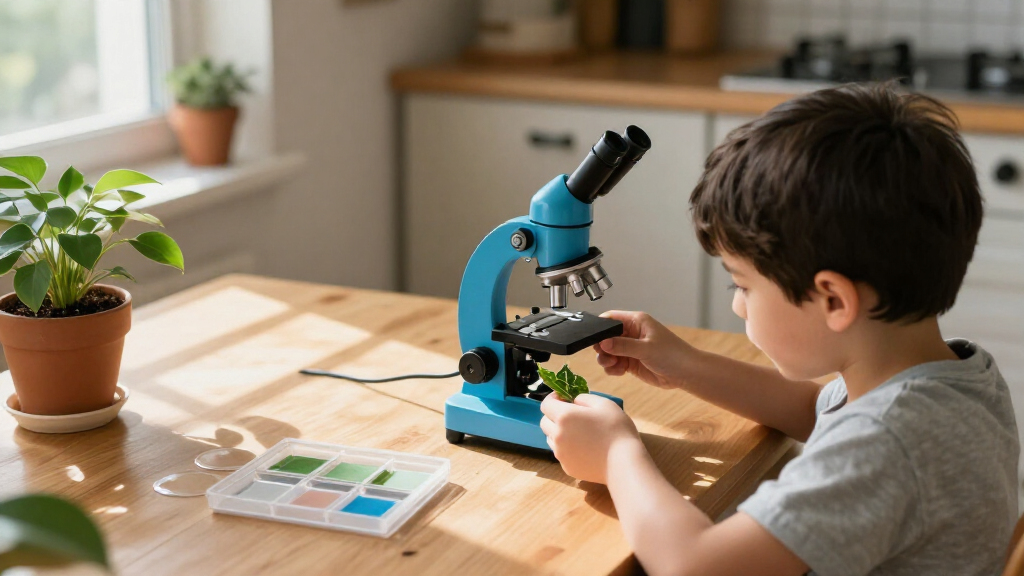
I compared these 15 microscope kits for kids by the parts of ownership that shape whether a child can use one independently: viewing style, focusing controls, lighting, stability, age fit, and how clearly the kit supports a first activity. I also weighed included slides and accessories by practical usefulness, not by piece count alone. Digital screens can help children share a view, while compound models offer a more direct introduction to optical microscopy; neither style suits every child.
The ranking favors usable learning experiences over the largest magnification number or accessory bundle. The National Geographic Dual LED kit ranks first for its balanced, approachable format, while the TOMLOV and AmScope options rise for distinct digital and traditional preferences. The remaining picks serve narrower needs, such as portable screen viewing, a beginner’s lower-magnification starting point, or a kit with many supplies. I treat advertised magnification as one factor, since lighting, focus control, and specimen quality affect what a child can actually see.
Factors to Consider When Choosing Microscope Kits For Kids
Before choosing among these kits, decide what kind of first experience you want: observing through an eyepiece, sharing a magnified image on a screen, or opening a box with slides and activities ready to try. The best fit depends as much on the child’s patience and supervision needs as on the microscope itself.
Choose the viewing style before comparing magnification
A compound microscope asks a child to look through an eyepiece, position a slide, and adjust focus, which can be rewarding but may require adult help at first. A digital model puts the image on a screen, making it easier for siblings or a parent to view together. Screens can also make observation feel more immediate, though they add another device feature to manage and may not teach the same eyepiece skills. Do not assume a digital display means the image will be clearer; lighting, focus, and sensor quality still matter. Pick the format your child is likely to return to, not the one with the most impressive-sounding specification.
Treat magnification claims as a starting point, not a score
High magnification is useful only when the optics, illumination, and focus controls can produce a usable image at that setting. For a younger beginner, a lower range can be less frustrating because familiar specimens are easier to locate and keep in view. Families buying for school-age experiments may want more range, but should also check whether the microscope has manageable focus adjustments and a stable base. A common mistake is choosing the largest advertised number without checking how the child will find a specimen. Prioritize a clear, steady view at practical settings over a maximum figure on the box.
Match the controls and setup to the child’s independence
Think about whether the child can place a slide, adjust the light, and focus without turning a short activity into a long setup session. Younger children often benefit from fewer fiddly steps and an adult nearby, while older children may enjoy learning precise adjustments. A sturdy base and controls that are easy to reach can matter more than a long list of functions. If the kit will be used at a kitchen table, consider how much space setup and slide handling require. Buy for the child’s current patience and coordination, rather than assuming they will immediately manage an advanced instrument alone.
Judge accessories by the experiments they make possible
Prepared slides give beginners something to view right away; blank slides allow them to collect and prepare their own specimens. A carrying case can help keep small parts together, while extra tools are only useful if the child has a clear activity for them. Large piece counts can sound generous but may include items that see little use. Before choosing a bundle, ask whether it supports a first session and offers enough variety for later exploration. A smaller set with a few relevant slides may be a better fit than a crowded kit that requires extra adult planning.
Plan for lighting, power, and where the kit will be used
Lighting affects whether a specimen is easy to see, especially when a child is still learning to focus. Dual lighting can offer flexibility for different kinds of samples, while a digital screen brings its own power and charging considerations. Check what power source the product requires and whether the family will use it mainly at a desk or carry it between rooms. A portable model is useful only if the controls and viewing experience remain manageable outside a fixed setup. Think about storage too: loose slides and small accessories are easier to use when they have a regular home.
Pay more for a real need, not a bigger number
A higher-feature model makes sense when its screen, broader controls, or more developed optical setup solves a specific problem for your household. For shared viewing, a digital display may be more valuable than a traditional eyepiece; for learning microscope technique, a compound model may offer the more relevant experience. If a child is just exploring whether microscopy interests them, a simpler beginner kit can reduce the cost of unused features. Avoid paying extra for magnification or accessories your child is unlikely to use. The right upgrade is the one that removes a recurring frustration or adds an activity the child genuinely wants to try.
Frequently Asked Questions
Should I choose a digital microscope or a traditional compound microscope for my child?
Choose a digital microscope when shared viewing and a screen-based experience are priorities; it can be easier for several people to follow the same observation. A traditional compound microscope is a better match when the goal is learning to use an eyepiece, position slides, and adjust focus. Digital models still need sound lighting and focus, and a screen does not guarantee a sharper image. Traditional models may ask for more patience, especially during early sessions. If your child is unsure about microscopy, consider which format will make them more willing to try a second specimen.
Is a kit with 1000x or higher magnification a better choice?
Not by itself. A large magnification claim does not tell you whether the image will be bright, sharp, or easy for a child to focus. The usefulness of that range depends on the optics, lighting, specimen, and stability of the microscope. Beginners often get more out of lower practical settings where they can find and recognize a sample. Compare controls and lighting alongside the maximum figure, and do not use magnification as the sole measure of quality.
What age is ready for a microscope kit without constant adult help?
Readiness depends more on a child’s coordination, patience, and comfort following small steps than on age alone. A child who can handle slides carefully and make gradual adjustments may work more independently, while another child of the same age may want help setting up and focusing. Prepared slides can shorten the first session, but they do not remove the need to handle parts carefully. For younger children, plan to supervise early use and store small accessories safely. Look for a kit whose controls and activities match the child you have, rather than relying only on an age label.
Are prepared slides worth choosing over blank slides?
Prepared slides are useful when you want a child to start observing quickly, with less preparation and fewer unknowns. Blank slides add room for collecting and preparing samples, which can support longer-term experimentation but may need more adult guidance. They are not interchangeable: one helps with a reliable first look, while the other invites a hands-on process. Families new to microscopy may value prepared slides first, then add blank-slide activities as the child gains confidence. Check the kit contents for the balance that suits your child’s interest and supervision level.
What should I prioritize if two kits list similar magnification ranges?
Compare the features that affect daily use: focus control, lighting, base stability, viewing format, and whether the included slides or tools support an activity. If the child will share observations with family, a screen may matter more than a slightly different magnification claim. If the goal is learning standard slide-based viewing, an eyepiece and manageable controls may be the better fit. Also check storage and power needs if the kit will travel or be put away after each session. Similar headline specifications can hide very different experiences for a young user.
Conclusion
For most families, I recommend the National Geographic Dual LED Microscope Science Kit as the best overall because its approachable science-kit format and lighting flexibility make it a balanced starting point. The National Geographic Junior Microscope Science Kit is my pick for beginners who may benefit from a simpler, lower-magnification introduction, while the Mileonaim kit is a value-minded choice for families who want prepared and blank slides in the same package. For a premium-style traditional setup, consider the AmScope M30-ABS-KT2-W; for screen-based sharing, compare the TOMLOV DM301K with the portable BMDSAE and larger-screen HEWEIMEI. Choose based on the child’s preferred viewing style and how much setup they can manage, not the biggest number printed on the box.