
Turkish names feature unique sounds shaped by the characters Ğ, Ş, and the dotless I. The Ğ lengthens vowels, creating a smooth, melodic flow, while Ş produces the “sh” sound, like in Şahin or Şule. The dotless I has a distinct pronunciation, similar to the Russian “ы,” and reflects Turkish linguistic roots. Understanding these sounds helps you pronounce names correctly and appreciate Turkish culture more fully — there’s plenty more to discover about these sounds.

Prime made for students and young adults
- Fast, free delivery for dorm and study essentials
- Prime Video and Amazon Music included
- Member-only deals
Key Takeaways
- The letter “Ğ” lengthens vowels and shapes the melodic flow of Turkish names without representing a distinct sound.
- “Ş” produces a “sh” sound, pronounced with the tongue near the palate, essential in names like Şahin or Şule.
- The dotless “I” (ı) represents a unique central vowel, crucial for correct pronunciation and cultural authenticity.
- Recognizing these sounds enhances understanding of Turkish phonetics, regional variations, and the cultural identity behind names.
- Proper pronunciation involves listening to native speakers and practicing the glide of “Ğ,” “Ş,” and the sound of “ı” for accuracy.
The Unique Role of the Letter Ğ in Turkish Names

Have you ever wondered why the letter Ğ holds such a special place in Turkish names? It’s all about Turkish phonetic nuances and how this unique alphabet character shapes pronunciation. Unlike other letters, Ğ doesn’t have a direct sound of its own; instead, it lengthens the preceding vowel, creating a smooth, flowing effect. This subtle feature adds a distinct rhythm to Turkish names, making them sound melodic and harmonious. You’ll notice that in names like “Mehmet” or “Ağda,” the Ğ influences how vowels are stretched, giving the name its characteristic sound. Its role isn’t just phonetic—it’s cultural, too, reflecting Turkish language’s rich history of unique alphabet characters that shape pronunciation and identity. Additionally, understanding the role of specific characters helps in accurately pronouncing and appreciating Turkish names and words.
Pronouncing the Ş: The Sound Behind the S in Names
When you see the letter Ş in Turkish names, it’s pronounced like the “Sh” in “shoe.” You’ll find it in common names like Şirin or Şahin, which showcase this unique sound. To pronounce it correctly, keep your tongue close to the roof of your mouth and push air out gently. Practicing with pronunciation techniques can help reinforce the correct way to produce this sound.
Articulating the “Sh” Sound
To pronounce the Turkish Ş sound correctly, you should position your tongue close to the roof of your mouth without touching it, then push air through the narrow gap to produce a gentle, hissing sound. This sound is integral to Turkish phonetics and often appears in names. Remember, vowel harmony influences pronunciation, so the surrounding vowels shape how Ş sounds in words. For example, the sound adapts smoothly within words following vowel harmony rules. The table below highlights key points:
| Aspect | Explanation | Example |
|---|---|---|
| Tongue position | Near the palate, not touching | Şehir |
| Airflow | Gentle, continuous, through narrow gap | Şişe |
| Vowel harmony | Shapes pronunciation based on neighboring vowels | Şaşırmak |
Mastering this sound enhances your Turkish pronunciation and understanding of phonetic rules. Understanding vowel harmony helps explain how sounds like Ş evolve within different words.
Common Name Examples
Are you curious about how the Ş sound appears in Turkish names? You’ll find it in many common names, reflecting cultural name variations and linguistic influences. For example, Şahin is a popular male name meaning “hawk,” symbolizing strength and freedom. Şule is a common female name meaning “moonlight,” showcasing poetic imagery. Names like Şener or Şükrü also highlight the Ş sound, often rooted in historical or religious significance. These names demonstrate how the Ş sound is woven into Turkish culture, maintaining tradition while adapting to modern naming trends. The pronunciation of Ş adds distinctiveness and identity to these names, connecting speakers to their cultural heritage. Recognizing these examples helps you appreciate the linguistic richness behind Turkish names and their unique sounds. Additionally, understanding the linguistic features of Turkish names can deepen your appreciation of their cultural significance.
Pronunciation Tips
Ever wondered how to pronounce the Ş in Turkish names correctly? Over time, historical pronunciation shifts have shaped how this letter sounds today. In modern Turkish, Ş is pronounced like the “sh” in “shoe,” but regional dialect variations can influence its subtle nuances. Some speakers might pronounce it slightly softer or more forcefully, depending on their area. Listening to native speakers from different regions helps you grasp these differences. Keep in mind that pronunciation can also evolve with time, reflecting both tradition and local accents. To sound natural, focus on producing a sharp “sh” sound, paying attention to regional cues. Practice by listening to Turkish names and names from various dialects, and you’ll improve your pronunciation confidence. Additionally, understanding how color accuracy and other phonetic elements influence speech can enhance your comprehension and pronunciation skills.
Understanding the Dotless I and Its Distinct Sound
Have you noticed the difference between the dotted and dotless I in Turkish? The dotless I has a unique sound that’s rooted in historical pronunciation shifts, reflecting how the language evolved. Originally, this character represented a distinct vowel sound, separate from the dotted I. Today, it’s essential to understanding Turkish spelling and pronunciation. The cultural significance of characters like the dotless I goes beyond phonetics; it symbolizes the language’s identity and history. When you see the dotless I, you’re encountering a letter that preserves a pronunciation that’s been maintained for centuries, linking past and present. Recognizing this difference helps you pronounce Turkish words correctly and appreciate the language’s rich cultural heritage. The dotless I isn’t just a letter—it’s a symbol of Turkish linguistic identity. Additionally, the distinct phonetic features of the dotless I are crucial for proper communication and comprehension in Turkish.
The Phonetic Characteristics of Turkish Vowels and Consonants
Turkish vowels and consonants each have distinct phonetic features that shape the language’s sound system. You’ll notice Turkish’s reliance on vowel harmony, where vowels within a word harmonize for front or back placement, creating fluidity. Consonant softening also plays a key role, often altering sounds based on surrounding vowels. Specifically:
- Turkish vowels are categorized into front and back groups, influencing vowel harmony.
- Consonant softening occurs when certain consonants change to softer sounds, especially near front vowels.
- Vowel harmony ensures vowels within a word are compatible, affecting suffix addition.
- Consonant softening enhances pronunciation smoothness, making speech more fluid and natural.
How Ğ, Ş, and the Dotless I Influence Turkish Name Rhythms
The consonants Ğ, Ş, and the dotless I play essential roles in shaping the rhythm and flow of Turkish names. Their influence stems from historical linguistic influences that have evolved over centuries, blending Turkic roots with Ottoman and Arabic elements. Regional pronunciation variations further affect how these sounds are perceived and articulated, giving Turkish names unique rhythmic qualities across different areas. For example, the softening of Ğ in some regions creates a gentle, elongated sound, while in others, it’s barely audible, influencing name cadence. Ş introduces a crisp, sharp consonant that punctuates names, adding a rhythmic accent. The dotless I contributes to the subtle vowel variation, impacting the overall musicality of names. Additionally, the phonetic characteristics of these characters are shaped by regional dialects, which further contribute to the diverse soundscape of Turkish naming conventions. Together, these characters give Turkish names their distinctive, melodious rhythm.
Common Turkish Names Featuring These Special Characters
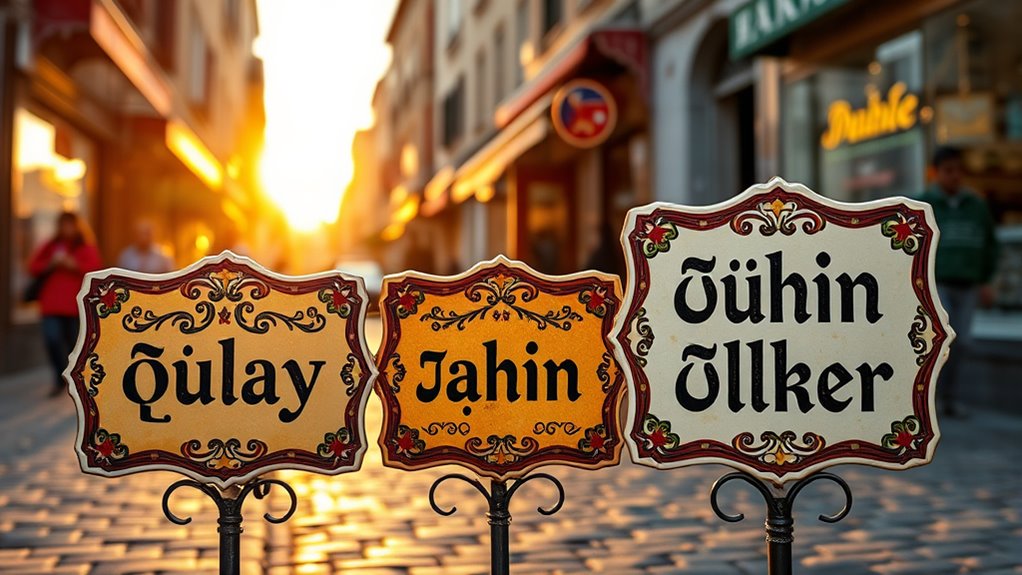
Many common Turkish names feature the distinctive characters Ğ, Ş, and the dotless I, which give them their unique sound and rhythm. These names reflect the Turkish alphabet history, where each letter plays a crucial role. For example:
Turkish names often include Ğ, Ş, and dotless I, shaping their distinctive sounds and regional pronunciations.
- Mehmet – A popular male name, where the soft Ğ influences pronunciation, with regional variations emphasizing different sounds.
- Şahin – A male name meaning “hawk,” with the Ş adding a sharp consonant sound.
- İlayda – A female name using the dotless I, highlighting regional pronunciation differences across Turkey.
- Şule – A feminine name where the Ş signifies a strong “sh” sound, common in various regions.
Additionally, these names demonstrate the influence of regional pronunciation variations that are shaped by the use of special characters in Turkish.
Challenges Non-Native Speakers Face With These Sounds

Since some Turkish sounds like Ğ, Ş, and the dotless I don’t exist in most other languages, non-native speakers often struggle to produce and distinguish these consonants accurately. Cultural pronunciation differences can cause confusion, leading you to substitute familiar sounds that don’t quite match. For example, the soft Ğ may be pronounced as a glide or omitted entirely, while the Ş might be confused with an S or SH sound. The dotless I, which has no equivalent in many languages, can be mispronounced as a regular I, changing the word’s meaning. These linguistic adaptation challenges make it hard to speak Turkish names authentically, often resulting in mispronunciations or misunderstandings. Overcoming these obstacles requires awareness of subtle sound distinctions and practice to develop accurate pronunciation. Additionally, understanding the phonetic nuances of these unique Turkish sounds can greatly improve pronunciation accuracy.
Tips for Pronouncing Turkish Names With Ğ, Ş, and Dotless I
Struggling to pronounce Turkish names with Ğ, Ş, and dotless I? Understanding cultural pronunciation differences and historical linguistic influences can help. Here are some tips:
- Practice the soft “Ğ” as a gentle glide between vowels, mimicking a brief pause, not a consonant.
- Pronounce “Ş” as the English “sh,” paying attention to its sharper, clearer sound.
- For the dotless “I,” focus on a sound similar to the Russian “ы,” which is a close, central vowel without a direct English equivalent.
- Listen to native speakers and repeat, noting subtle pronunciation nuances rooted in Turkey’s linguistic history. This practice helps internalize the sounds more naturally, respecting the cultural and historical context behind each pronunciation.
- Recognizing the influence of linguistic history can deepen your understanding of these unique sounds and improve your pronunciation skills.
Frequently Asked Questions
How Does the Letter Ğ Affect the Pronunciation of Adjacent Vowels?
When you see the letter ğ, it subtly influences the pronunciation of nearby vowels by lengthening them through phonetic influence. This vowel lengthening makes the vowels sound a bit longer and smoother, without adding a distinct sound itself. So, if ğ is next to a vowel, it doesn’t produce a separate sound but instead affects the vowel’s quality and duration, creating a more fluid and natural pronunciation.
Are There Regional Variations in Pronouncing Ş Across Turkey?
You’ll notice regional dialects cause pronunciation differences for “ş” across Turkey. In some areas, especially in the east, people pronounce it more sharply, while in the west, it tends to be softer. These regional variations in pronunciation reflect local dialects and accents, so your experience with “ş” might differ depending on where you’re in Turkey. Overall, though, the sound remains recognizable regardless of the region.
Why Is the Dotless I Considered a Separate Letter in Turkish?
You’ll find that the dotless I is considered a separate letter in the Turkish alphabet because it has a unique pronunciation that differs from the dotted I. This distinction highlights the Turkish alphabet’s uniqueness, emphasizing correct letter pronunciation differences. By recognizing the dotless I as a separate letter, you guarantee accurate spelling and pronunciation, which is essential for clear communication and preserving the language’s phonetic integrity.
Can Non-Native Speakers Easily Learn to Pronounce These Turkish Sounds?
You can definitely learn to pronounce these Turkish sounds, but you might face some pronunciation challenges at first. To succeed, use learning strategies like listening to native speakers and practicing regularly. Focus on sounds like Ğ, Ş, and the dotless I, which are unique. With patience and consistent effort, you’ll improve your pronunciation and feel more confident speaking Turkish. Keep practicing, and you’ll master these sounds over time.
What Are Some Common Turkish Names That Include These Special Characters?
Imagine opening a treasure chest of Turkish names, where Ğ, Ş, and the dotless I sparkle like rare jewels. Names like Şirin, Çağla, and Hüseyin showcase these special characters, carrying deep cultural significance through diacritics. These names aren’t just labels; they’re stories woven into the language’s fabric, making each one a unique emblem of Turkish heritage that you can embrace with pride and curiosity.
Conclusion
So, next time you stumble over Turkish names with Ğ, Ş, or dotless I, remember you’re actually steering a rich tapestry of sounds, not just tongue-twisters. Embrace the challenge — it’s a small price to pay for sounding like you’ve mastered a secret code. After all, mispronouncing them might just earn you a lifetime of confused looks, or worse, offending someone’s heritage. Better to learn and impress than to keep bungling around, right?
Halloween Picks
halloween
As an affiliate, we earn on qualifying purchases.