
For a balanced first deck, School Zone Alphabet Flash Cards are my best overall pick, while Carson Dellosa Alphabet Flash Cards suit families who want a straightforward alphabet-focused set. Think Tank Scholar Preschool and Kindergarten Flash Cards stand out for buyers seeking several subjects in one large collection. The main choice is between a focused alphabet deck that keeps practice simple and a broader set that offers more variety but can add clutter or distract from letter learning. I also weigh card count, double-sided layouts, and whether Spanish or matching activities fit a child’s learning goals. Read on for the full breakdown and recommendations by buyer type.

Prime made for students and young adults
- Fast, free delivery for dorm and study essentials
- Prime Video and Amazon Music included
- Member-only deals
Key Takeaways
- Alphabet-first decks are easier to keep focused: School Zone and Carson Dellosa center the choice on letter practice, while many other sets mix letters with numbers, shapes, or colors.
- More cards do not automatically mean better alphabet practice: Think Tank Scholar and the 220-card Preschool Toddler set cover more material, but their breadth may be unnecessary for a learner working on the ABCs.
- Double-sided designs can stretch a deck’s use: QUOKKA, Learnworx’s 52-card set, and Merka pair alphabet material with additional learning content, trading a compact card count for denser cards.
- Specialized learning goals call for specialized picks: Spanish Alphabet Flash Cards address language learning, while Matching Letter and Math Learning Game adds a game-based activity rather than a conventional alphabet deck.
- Mixed-subject toddler sets vary more in scope than their names suggest: Skillmatics, Torlam, and ZazzyKid combine early-learning topics, so buyers should prioritize the subjects they want rather than choosing by broad labels alone.
| Skillmatics Flash Cards for Toddlers: Letters, Numbers, Shapes & Colors |  | Best for Guided, Multi-Skill Learning | Brand: Skillmatics | Age range: 18 months to 4 years | Card count: 50 double-sided cards | VIEW LATEST PRICE | See Our Full Breakdown |
| QUOKKA Educational Flash Cards for Kids, 60 Double-Sided Alphabet and Learning Cards |  | Best for Topic Variety | Brand: QUOKKA | Card count: 60 double-sided cards | Dimensions: 3.94 × 2.56 × 0.04 inches | VIEW LATEST PRICE | See Our Full Breakdown |
| Torlam Toddler Flash Cards for Early Learning |  | Best for Bigger Cards and Easy Sorting | Brand: Torlam | Recommended age: 3 years and up | Card count: 60 double-sided cards | VIEW LATEST PRICE | See Our Full Breakdown |
| Carson Dellosa Alphabet Flash Cards, 54 Count |  | Best for Focused Letter Recognition | Brand: Carson Dellosa | Quantity: 54 flash cards | Learning focus: Alphabet and letter recognition | VIEW LATEST PRICE | See Our Full Breakdown |
| Matching Letter and Math Learning Game for Kids |  | Best for Interactive Spelling Practice | Brand: WELLYOGA | Recommended age: 36 months to 8 years | Players: 1 or more | VIEW LATEST PRICE | See Our Full Breakdown |
| Learnworx Alphabet Flash Cards for Toddlers, 52 Double-Sided Cards |  | Best for Letter-and-Sound Practice | Brand: Learnworx | Card count: 52 double-sided cards | Letter coverage: A–Z, uppercase and lowercase | VIEW LATEST PRICE | See Our Full Breakdown |
| ZazzyKid Toddler Flash Cards: Alphabet, Numbers, Colors, and Shapes |  | Best Compact Multi-Topic Set | Brand: ZazzyKid | Card count: 54 double-sided cards | Contents: 26 alphabet, 10 number, 10 color, and 8 shape cards | VIEW LATEST PRICE | See Our Full Breakdown |
| Think Tank Scholar Preschool and Kindergarten Flash Cards, 5 Decks, 180 Cards | 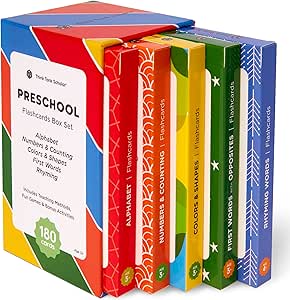 | Best for a Broader Preschool Curriculum | Brand: Think Tank Scholar | Card count: 180 | Deck count: 5 | VIEW LATEST PRICE | See Our Full Breakdown |
| Spanish Alphabet Flash Cards for Kids |  | Best for Spanish-Language Learning | Brand: THE BAMBINO TREE | Age range: 3–6 years | Educational skills: Language, phonics, and reading | VIEW LATEST PRICE | See Our Full Breakdown |
| Learnworx 101 Flash Cards for Toddlers |  | Best for Wipe-Clean, All-Around Learning | Brand: Learnworx | Card count: 101 double-sided cards | Age range: 12 months–5 years | VIEW LATEST PRICE | See Our Full Breakdown |
| School Zone Alphabet Flash Cards, 56 Cards |  | Best for Focused Letter Practice | Card count: 56 | Card contents: 26 uppercase letter cards, 26 lowercase letter cards, 3 index cards, and 1 parent card | Card dimensions: 3.0 × 5.575 inches | VIEW LATEST PRICE | See Our Full Breakdown |
| Merka Toddler Alphabet, Number, and Shape Flash Cards, 64 Double-Sided Cards |  | Best Multi-Topic Starter Set | Card count: 64 in title; some item details list 58 | Card format: Double-sided | Card dimensions: 4.2 × 2.4 inches | VIEW LATEST PRICE | See Our Full Breakdown |
| Preschool Toddler Flash Cards Set, 4 Boxes, 220 Cards |  | Best for Broad Preschool Practice | Set size: 4 boxes | Card count: 220 | Topics: Alphabet, numbers, animals, colors, and shapes | VIEW LATEST PRICE | See Our Full Breakdown |
| alphabet learning flash card | Brand | Card count | Material | Recommended age |
|---|---|---|---|---|
| Skillmatics Flash Cards for To | Skillmatics | 50 double-sided cards | — | — |
| QUOKKA Educational Flash Cards | QUOKKA | 60 double-sided cards | Cardstock | 12 months and up; age guidance is inconsistent in the description |
| Torlam Toddler Flash Cards for | Torlam | 60 double-sided cards | Cardboard | 3 years and up |
| Carson Dellosa Alphabet Flash | Carson Dellosa | — | — | — |
| Matching Letter and Math Learn | WELLYOGA | — | — | 36 months to 8 years |
| Learnworx Alphabet Flash Cards | Learnworx | 52 double-sided cards | Cardboard | 12 months–8 years |
| ZazzyKid Toddler Flash Cards: | ZazzyKid | 54 double-sided cards | Paper card with laminated finish | 12 months to 8 years |
| Think Tank Scholar Preschool a | Think Tank Scholar | 180 | — | 36 months to 8 years |
| Spanish Alphabet Flash Cards f | THE BAMBINO TREE | 54 double-sided cards | Cardboard | — |
| Learnworx 101 Flash Cards for | Learnworx | 101 double-sided cards | Ultra-thick double-sided card | — |
| School Zone Alphabet Flash Car | School Zone | 56 | — | — |
| Merka Toddler Alphabet | — | 64 in title; some item details list 58 | Cardstock | 18 months–4 years |
| Preschool Toddler Flash Cards | — | 220 | — | — |
More Details on Our Top Picks
Skillmatics Flash Cards for Toddlers: Letters, Numbers, Shapes & Colors
For families who want alphabet practice folded into a broader preschool routine, Skillmatics offers one of the clearest learning paths in this group. Its 50 double-sided cards cover letters and phonics alongside numbers, shapes, colors, and sorting, while the included guide suggests activities rather than leaving caregivers to invent each session. The 5.4 × 3.5-inch format is larger than QUOKKA’s cards, which may be easier for younger children to grip and inspect. That breadth is also the tradeoff: the alphabet gets less dedicated practice than it would in a focused set such as Carson Dellosa’s alphabet-only cards. The plastic-free, sturdy construction suits repeat handling, but the content is aimed at ages 18 months to 4 years and may feel basic once a child moves beyond preschool concepts.
Pros:- Combines letters and phonics with numbers, shapes, colors, and counting
- Learning guide provides sorting games and activity ideas
- Large cards are sized for young children to handle
- Sturdy, plastic-free, recyclable materials
Cons:- Broad topic coverage means less concentrated alphabet practice than Carson Dellosa’s letter-focused deck
- Preschool-level content may offer limited value as children advance beyond the stated age range
Best for: Caregivers of children ages 18 months to 4 years who want alphabet and phonics practice alongside other first-learning topics, with activities to guide play.
Not ideal for: Families seeking a focused alphabet deck for an older preschooler, or children ready for more advanced reading and spelling practice.
- Brand:Skillmatics
- Age range:18 months to 4 years
- Card count:50 double-sided cards
- Card dimensions:5.4 × 3.5 inches
- Materials:Plastic-free, recyclable
- Included components:50 double-sided cards and 1 learning guide
- Learning topics:Letters, numbers, shapes, colors, phonics, letter sounds, counting, classifying, and sorting
Our verdict“Choose Skillmatics for guided alphabet-and-phonics play that also covers several other early-learning skills.”
QUOKKA Educational Flash Cards for Kids, 60 Double-Sided Alphabet and Learning Cards
QUOKKA is a good match for families who want alphabet cards to double as prompts for everyday vocabulary. The 60 double-sided cards span letters, numbers, body parts, vehicles, foods, animals, and emotions, and the reverse sides include activities and games. That makes the deck more varied than Carson Dellosa’s alphabet-focused set, although it also means less of the pack is devoted to letters alone. Large fonts and clear illustrations support quick recognition, and the wipe-clean finish is practical for frequent handling. The main compromise is size: at 3.94 × 2.56 inches, these cards are smaller than Torlam’s, so some young children may find them harder to hold. The listing also gives inconsistent age recommendations, so I would not choose it based on a precise age threshold.
Pros:- Covers alphabet learning plus a broad range of vocabulary and early-learning topics
- Double-sided cards include activities and games
- Large fonts and clear illustrations aid recognition
- Wipe-clean cardstock and rounded corners suit repeated handling
Cons:- Small dimensions may be difficult for some children to handle
- Broad topic coverage leaves less room for concentrated alphabet practice
- Age recommendations are inconsistent in the product information
Best for: Families who want one compact deck for alphabet practice, early vocabulary, and a range of preschool topics, especially if wipe-clean cards are useful.
Not ideal for: Caregivers prioritizing larger cards for small hands or a clearly defined age range, or buyers wanting a deck dedicated mainly to alphabet learning.
- Brand:QUOKKA
- Card count:60 double-sided cards
- Dimensions:3.94 × 2.56 × 0.04 inches
- Material:Cardstock
- Recommended age:12 months and up; age guidance is inconsistent in the description
- Topics:Alphabet, numbers, counting, body parts, colors, shapes, vehicles, fruits, vegetables, animals, and emotions
- Cleaning:Wipe clean with a damp cloth
Our verdict“Pick QUOKKA if you want a wipe-clean, varied vocabulary deck rather than a narrowly focused alphabet set.”
Torlam Toddler Flash Cards for Early Learning
Torlam stands out for children who benefit from a larger card surface and a simple way to keep a session organized. Its 4.9 × 3.9-inch cards are bigger than QUOKKA’s, giving illustrations and text more room and making the cards easier for small hands to manage. The five colored rings can group cards or keep selected topics together, a practical advantage over Skillmatics, which relies on a learning guide rather than sorting accessories. The deck covers the alphabet, numbers, shapes, colors, and vocabulary topics such as animals and foods, so it works as a broad early-learning resource, not an alphabet-only drill set. Its stated age recommendation of 3 years and up is a real limitation for families shopping for younger toddlers, and the cardboard construction is not described as wipe-clean.
Pros:- Larger card dimensions than QUOKKA’s make cards easier to see and handle
- Includes five colored rings for grouping or organizing cards
- Combines alphabet practice with numbers, shapes, colors, and vocabulary
- Rounded edges and colorful illustrations support child-friendly handling
Cons:- Recommended only for ages 3 and up, so it does not suit younger toddlers
- Wide topic mix provides less concentrated alphabet practice than a dedicated letter deck
- Cardboard material is not specified as wipe-clean
Best for: Families with children ages 3 and up who prefer larger illustrated cards and want rings to organize a mixed-topic learning deck.
Not ideal for: Caregivers of children under 3, or anyone seeking a narrowly focused alphabet deck or a stated wipe-clean surface.
- Brand:Torlam
- Recommended age:3 years and up
- Card count:60 double-sided cards
- Card dimensions:4.9 × 3.9 inches
- Material:Cardboard
- Included accessories:5 colored rings
- Learning topics:Alphabet, numbers 1–10, shapes, colors, animals, first words, body parts, and foods
Our verdict“Choose Torlam for larger, ring-organized cards for preschoolers, but not for younger toddlers or focused letter drills.”
Carson Dellosa Alphabet Flash Cards, 54 Count
When the priority is practicing the alphabet without a bundle of unrelated preschool topics, Carson Dellosa is the most direct option in this batch. Its 54-card alphabet set is described as supporting letter recognition, so it keeps the learning goal narrower than the Skillmatics and QUOKKA decks, which divide attention across several subjects. That focus can make it a straightforward choice for brief letter-review sessions, but the available product details are sparse: they do not specify card dimensions, material, age range, illustrations, or extra activities. Compared with Skillmatics, there is also no listed learning guide to help caregivers structure play. I would choose it for a simple alphabet resource, not for a richer phonics program or a multi-topic set that grows into broader vocabulary practice.
Pros:- Keeps the learning focus on alphabet and letter recognition
- Includes 54 flash cards
- A simpler alternative to multi-topic decks such as Skillmatics and QUOKKA
Cons:- Product information does not specify card dimensions or material
- No learning guide, activities, or additional phonics features are listed
- Narrow focus offers less variety than multi-topic alternatives
Best for: Caregivers and early-learning settings that want a straightforward set of cards for letter recognition without extra topic coverage.
Not ideal for: Buyers who need confirmed card size, material, age guidance, phonics content, or built-in activities before choosing a deck.
- Brand:Carson Dellosa
- Quantity:54 flash cards
- Learning focus:Alphabet and letter recognition
- Product format:Flash cards
- Age range:Not specified in the product data
- Card dimensions:Not specified in the product data
Our verdict“Pick Carson Dellosa when straightforward letter recognition matters more than extra topics or listed teaching aids.”
Matching Letter and Math Learning Game for Kids
This WELLYOGA set is the most game-like choice here, shifting alphabet learning from showing and naming cards to building words with cubes and matching pieces. Its 32 double-sided cards present 64 words and 64 math problems, while the letter cubes, number tiles, tray, and hint-and-cover mode add hands-on spelling and memory practice. Compared with Carson Dellosa’s straightforward letter-recognition deck, this is better suited to children ready to assemble words and tackle basic math; it is also a bigger activity system than Skillmatics’ cards and learning guide. That extra interaction brings a tradeoff: it has many small components, and the product warns against use under age 3 because of choking risk. It is not the simplest choice for quick alphabet drills or families who want a low-piece-count card deck.
Pros:- Combines spelling and vocabulary practice with counting and basic math
- Letter cubes and matching tray turn word practice into a hands-on activity
- Hint-and-cover mode adds memory practice
- Can be played solo or with family and classmates
Cons:- Contains small parts and is not suitable for children under 3
- Many tiles and pieces require more organization than a basic flash-card deck
- Math content competes with alphabet practice for attention
Best for: Families or classrooms with children ages 3 to 8 who are ready to practice spelling and sight words through hands-on matching, with math activities as an added subject.
Not ideal for: Children under 3, buyers seeking a simple alphabet-only flash-card deck, or caregivers who want to avoid managing multiple small pieces.
- Brand:WELLYOGA
- Recommended age:36 months to 8 years
- Players:1 or more
- Flash cards:32 double-sided cards featuring 64 words and 64 math problems
- Letter cubes:10
- Number and math tiles:20 number tiles and 5 math symbol tiles
- Other components:1 matching tray and 25 magnetic soft stickers
- Safety:Contains small parts; not suitable for children under 3
Our verdict“Choose WELLYOGA for interactive spelling and math play with older preschoolers, not for simple alphabet review or under-3s.”
Learnworx Alphabet Flash Cards for Toddlers, 52 Double-Sided Cards
For a focused start with the alphabet, this Learnworx set pairs uppercase and lowercase letters with animal and object pictures that can prompt letter-name and sound practice. Its 52 cards keep the scope centered on A–Z, unlike the broader Learnworx 101 Flash Cards, which also covers numbers, shapes, and other early topics. That narrower focus makes it easier to build matching and quick-recognition games around letters alone. The 5 x 3.75-inch cards offer room for illustrations, though the listing gives differing card dimensions, so buyers should not rely on the stated size without checking. Cardboard construction is less suited to rough or wet handling than wipe-clean cards. I’d choose it for simple alphabet routines, not for a durable all-subject set.
Pros:- Pairs uppercase and lowercase letters across A–Z
- Animal and object illustrations support letter-name and sound prompts
- One letter per card lends itself to matching and focused practice
- Includes a summary card and storage box
Cons:- Cardboard may wear with frequent handling or spills
- The product description gives differing card dimensions
Best for: Caregivers who want a dedicated A–Z set for matching uppercase and lowercase letters and practicing letter sounds with toddlers or preschoolers.
Not ideal for: Families seeking wipe-clean cards, a broad mix of learning topics, or confidence in exact card dimensions.
- Brand:Learnworx
- Card count:52 double-sided cards
- Letter coverage:A–Z, uppercase and lowercase
- Card size:5 x 3.75 inches (dimensions vary in the description)
- Material:Cardboard
- Included components:Flash cards, summary card, storage box
- Recommended age:12 months–8 years
- Educational use:Preschool alphabet and letter-sound learning
Our verdict“Choose this set for focused uppercase, lowercase, and sound practice; pick the Learnworx 101 set if you want more subjects and wipe-clean surfaces.”
ZazzyKid Toddler Flash Cards: Alphabet, Numbers, Colors, and Shapes
ZazzyKid fits four early-learning subjects into 54 double-sided cards, including 26 alphabet cards alongside numbers, colors, and shapes. That makes it a practical choice for caregivers who want to switch activities without keeping several decks on hand. The laminated finish is a step up from the cardboard construction of Learnworx’s 52-card alphabet set, but the cards are still paper-based and may wear with frequent handling. The tradeoff for the mixed curriculum is less room for alphabet-only practice: this set cannot offer the same letter-focused repetition as a dedicated A–Z deck. At 5 x 3.5 inches, its format suits home or preschool activities, though the overall subject range remains introductory rather than extensive.
Pros:- Combines alphabet, number, color, and shape cards
- Laminated finish adds a layer of protection to the paper cards
- Pictures and matching words support visual learning
- Sized for home and preschool activities
Cons:- Paper cards can still wear with frequent handling
- Only 26 cards focus on the alphabet, limiting letter-specific repetition
Best for: Parents and preschool educators who want one small deck for rotating between alphabet recognition, numbers, colors, and shapes.
Not ideal for: Buyers seeking in-depth alphabet practice or tougher cards for heavy, repeated handling.
- Brand:ZazzyKid
- Card count:54 double-sided cards
- Contents:26 alphabet, 10 number, 10 color, and 8 shape cards
- Material:Paper card with laminated finish
- Dimensions:5 x 3.5 inches
- Recommended age:12 months to 8 years
- School type:Preschool
- Model:Toddler Flash Cards
Our verdict“Pick ZazzyKid for a compact mix of early topics, but choose Learnworx’s dedicated alphabet set when letter practice is the main goal.”
Think Tank Scholar Preschool and Kindergarten Flash Cards, 5 Decks, 180 Cards
The alphabet deck is only one part of this 180-card, five-deck set, which also covers first words and opposites, colors and shapes, numbers and counting, and rhyming. Its bold text and real-life photos give adults material to connect letters with familiar objects, while the charts and included games offer ways to extend practice beyond simple card naming. Compared with ZazzyKid’s 54-card mixed-topic set, Think Tank Scholar provides more subject coverage and teaching aids, but also asks for more storage and organization. Its 3.1 x 5.2-inch cards are described as jumbo, though they are narrower than the larger Learnworx alphabet cards. Recommended from age three, it is a better fit for preschool and kindergarten activities than for toddlers just starting with letter recognition.
Pros:- Five decks cover alphabet, words, opposites, colors, shapes, numbers, counting, and rhyming
- Bold text and real-life photos can link letters and words to familiar subjects
- Includes reference charts, a color wheel, and a shape index
- Teaching methods and games offer activity ideas beyond recitation
Cons:- The 180-card set needs more storage and organization than a single alphabet deck
- Recommended age starts at 36 months, making it less suited to younger toddlers
- The alphabet is one section of a broad set rather than the sole focus
Best for: Preschool and kindergarten families or educators who want alphabet cards within a multi-deck set that also supports early language and math activities.
Not ideal for: Caregivers who want a small, alphabet-only deck, need toddler-age materials, or prefer a minimal storage footprint.
- Brand:Think Tank Scholar
- Card count:180
- Deck count:5
- Cards per deck:36
- Card size:3.1 x 5.2 inches
- Recommended age:36 months to 8 years
- Educational objectives:Language skills, math skills, spatial reasoning, visual perception
- Included components:5 flash card decks, alphabet reference chart, color wheel card, numbers 1–120 chart, shape index card
Our verdict“Choose Think Tank Scholar when alphabet practice is part of a wider preschool curriculum, not when you need a simple A–Z deck.”
Spanish Alphabet Flash Cards for Kids
This set is the clear specialist in the lineup: it covers the 27 letters of the Spanish alphabet, with more than 100 example words and instructions in both Spanish and English. The color-coded five-level SATPIN system gives practice a more structured path than the general A–Z cards from Learnworx, while five games and sorting rings support hands-on review. Uppercase and lowercase cards also make matching and early spelling activities possible. That structure is useful for Spanish phonics, but it is a less direct fit for families looking for English alphabet instruction. The cardboard cards are substantial in the description, yet they are not described as wipe-clean. At ages three to six, the set is aimed at young learners rather than older students who need advanced language work.
Pros:- Covers all 27 Spanish letters and includes more than 100 example words
- Uppercase and lowercase cards support matching and spelling practice
- Color-coded SATPIN levels and five games add structure to review
- Includes five sorting rings and bilingual instructions
Cons:- Designed for ages three to six, so it may not suit older learners
- Cardboard construction is not described as wipe-clean
- Spanish-focused content is not a substitute for an English alphabet deck
Best for: Bilingual families and early-childhood teachers who want structured Spanish letter and sound practice with English-language instructions available.
Not ideal for: Buyers seeking English-only alphabet cards, wipe-clean materials, or lessons for older students.
- Brand:THE BAMBINO TREE
- Age range:3–6 years
- Educational skills:Language, phonics, and reading
- Card count:54 double-sided cards
- Components:5 sorting rings, 54 flash cards, instruction sheet
- Card size:4.75 x 3.5 inches
- Material:Cardboard
- Languages:Spanish and English
Our verdict“Choose this set for Spanish phonics and letter practice; use an English-focused deck such as Learnworx if English A–Z is the priority.”
Learnworx 101 Flash Cards for Toddlers
Alphabet practice here comes as part of a 101-card early-learning set covering letters, numbers, counting, colors, shapes, animals, and body parts. Double-sided prompts, questions, and activities give adults more ways to engage a child than a basic letter-and-picture deck. The wipe-clean surfaces and soft corners also make this a more practical choice for frequent use than the cardboard Learnworx 52-card alphabet set, though the listing does not resolve conflicting card-size measurements. The broad topic mix is the main compromise: children get less alphabet-only repetition, and the set is designed for ages 12 months to five years rather than older learners. I’d favor it for shared early-learning sessions where durability and variety matter more than a narrowly focused A–Z routine.
Pros:- Covers letters alongside numbers, counting, colors, shapes, animals, and body parts
- Double-sided cards include questions and activities
- Ultra-thick cards have wipe-clean surfaces and soft corners
- Includes a sturdy keepsake box
Cons:- Broad topic coverage means less space for alphabet-only practice
- The listing gives conflicting card-size measurements
Best for: Families with children ages one to five who want wipe-clean cards for rotating between alphabet practice and other foundational topics.
Not ideal for: Buyers who want a dedicated alphabet deck, lessons for children over five, or clear confirmation of card dimensions.
- Brand:Learnworx
- Card count:101 double-sided cards
- Age range:12 months–5 years
- Educational topics:Letters, numbers, counting, colors, shapes, animals, body parts
- Card size:5 x 3.75 inches (measurements conflict in the listing)
- Material:Ultra-thick double-sided card
- Features:Soft corners, wipe-clean surfaces
- Package:Sturdy keepsake box
Our verdict“Pick this set for durable, varied early-learning sessions; choose the 52-card Learnworx deck for more focused alphabet practice.”
School Zone Alphabet Flash Cards, 56 Cards
For families prioritizing the alphabet over a broad preschool curriculum, School Zone’s 56-card set keeps practice centered on letter recognition and early phonics. Separate uppercase and lowercase cards, paired with pictures, let a child connect letter forms with sounds and familiar words. The parent card’s activity ideas also offer a starting point for playful practice, unlike a set that leaves caregivers to invent each game. Compared with Merka’s cards, which also introduce numbers and shapes, this set gives up topic variety for a clearer alphabet focus. Its portable size and rounded corners suit little hands and outings, but the cards are aimed at early learners; older preschoolers ready for more advanced reading work may outgrow them quickly.
Pros:- Separate uppercase and lowercase cards support matching letter forms
- Letter-picture associations help connect symbols with familiar words
- Parent card provides game and activity ideas
- Portable cards with rounded corners are suited to small hands
Cons:- Focuses on early alphabet skills, so it may offer little challenge to older learners
- Does not cover numbers or shapes like Merka’s multi-topic set
Best for: Caregivers of children ages 3 and up who want a portable, alphabet-centered set with prompts for guided practice
Not ideal for: Families seeking one deck for letters, numbers, and shapes, or older children who already recognize letters and need more advanced challenges
- Card count:56
- Card contents:26 uppercase letter cards, 26 lowercase letter cards, 3 index cards, and 1 parent card
- Card dimensions:3.0 × 5.575 inches
- Age range:3 years and up
- Language:English
- Brand:School Zone
- Educational skills:Alphabet recognition, phonics, letter-picture association, and early reading
Our verdict“Choose School Zone for guided, portable alphabet practice for a young learner; pick Merka instead if you want numbers and shapes in the same set.”
Merka Toddler Alphabet, Number, and Shape Flash Cards, 64 Double-Sided Cards
Merka suits toddlers whose learning routine moves between letters, numbers, and shapes rather than staying with the alphabet alone. Its double-sided cards put content on both sides, while the laminated finish is intended to withstand repeated handling. At 4.2 × 2.4 inches, the compact format is designed for small hands and travel. Compared with School Zone’s alphabet-focused deck, Merka offers more subject variety but less emphasis on a dedicated uppercase-and-lowercase sequence or parent-led alphabet activities. There is also a quantity discrepancy: the title says 64 cards, while some item details list 58. That uncertainty makes it harder to know exactly what arrives, so I’d favor this set for flexible, short practice sessions rather than buyers who need a clearly specified alphabet deck.
Pros:- Combines alphabet, number, and shape learning in one set
- Double-sided format uses both sides of each card for learning content
- Compact dimensions are designed for small hands and travel
- Laminated finish is intended for repeated use
Cons:- Listing conflicts between 64 cards in the title and 58 in some item details
- Broader topic coverage is less alphabet-focused than School Zone’s dedicated letter set
Best for: Caregivers of children ages 18 months to 4 years who want compact cards spanning letters, numbers, and shapes
Not ideal for: Buyers who need a confirmed card count or a set focused on detailed uppercase-and-lowercase alphabet practice
- Card count:64 in title; some item details list 58
- Card format:Double-sided
- Card dimensions:4.2 × 2.4 inches
- Material:Cardstock
- Finish:Laminated
- Language:English
- Recommended age:18 months–4 years
- Learning topics:Alphabet, numbers, and shapes
Our verdict“Choose Merka for toddler-friendly variety across three topics, but select School Zone if alphabet practice and a clearly stated card breakdown matter more.”
Preschool Toddler Flash Cards Set, 4 Boxes, 220 Cards
This four-box set is the broadest option in this batch, with 220 cards across five topics: alphabet, numbers, animals, colors, and shapes. That range can suit families who want one collection to support different early-learning activities, rather than a deck devoted to letter recognition like School Zone. The four-box organization may also make it easier to separate topics during practice, though the available product details do not explain how the cards are divided among boxes or what alphabet-specific features they include. Unlike Merka, whose format and laminated finish are specified, this listing gives no card dimensions, material, age range, or other construction details. I’d choose it for breadth and a large selection, not for buyers who need a well-documented, tightly structured alphabet-learning deck.
Pros:- Covers the alphabet, numbers, animals, colors, and shapes
- 220 cards provide a large pool of material for varied practice
- Four boxes separate the collection into organized groups
Cons:- Product details do not specify the alphabet activities or letter-card format
- Card dimensions, materials, and age guidance are not provided
- The large collection may be less convenient for quick, focused sessions than School Zone’s smaller alphabet deck
Best for: Families and preschool educators who want a large card collection spanning the alphabet and several other early-learning topics
Not ideal for: Caregivers seeking detailed alphabet-specific guidance, confirmed card construction or dimensions, or a smaller set for travel
- Set size:4 boxes
- Card count:220
- Topics:Alphabet, numbers, animals, colors, and shapes
Our verdict“Pick this set for broad preschool topic coverage and a large card pool, but choose School Zone for clearer, more focused alphabet practice.”

How We Picked
I ranked these alphabet learning flash cards by how directly they support letter learning, how clearly their stated format suits a child’s stage, and how useful their extra subjects or activities are to the intended buyer. I also considered card count and double-sided layouts as practical tradeoffs: a larger set can serve more learning goals, while a focused, smaller deck may be easier to use for short alphabet sessions.
The order favors products with a clear role in an alphabet-learning routine, then accounts for broader sets that trade focus for variety and specialized options for particular needs. Since the product names and listed specifications do not establish details such as card thickness, illustration style, or exact letter-case coverage, I do not treat those as proven advantages. Buyers should check the package details for those specifics before choosing.
| alphabet learning flash card | Material |
|---|---|
| Skillmatics Flash Cards for To | — |
| QUOKKA Educational Flash Cards | Cardstock |
| Torlam Toddler Flash Cards for | Cardboard |
| Carson Dellosa Alphabet Flash | — |
| Matching Letter and Math Learn | — |
| Learnworx Alphabet Flash Cards | Cardboard |
| ZazzyKid Toddler Flash Cards: | Paper card with laminated finish |
| Think Tank Scholar Preschool a | — |
| Spanish Alphabet Flash Cards f | Cardboard |
| Learnworx 101 Flash Cards for | Ultra-thick double-sided card |
| School Zone Alphabet Flash Car | — |
| Merka Toddler Alphabet | Cardstock |
| Preschool Toddler Flash Cards | — |
Factors to Consider When Choosing Alphabet Learning Flash Cards
Choosing a deck is less about finding the highest card count and more about matching the cards to the way a child will practice. These factors can help you decide whether to prioritize a simple ABC routine, several subjects in one box, or a specialized learning goal.
Decide Whether Alphabet Practice Should Stay Focused
A deck devoted mainly to letters can make it easier to repeat the same learning routine without shifting between unrelated topics. Mixed sets may keep activities varied, but they can also pull attention toward numbers, colors, and shapes before a child has settled into letter recognition. A common mistake is choosing a broad set because it contains more material, then using only a small part of it. If your immediate goal is recognizing letters, give alphabet emphasis more weight than total card count. If you want one resource for several early-learning subjects, the added breadth may be useful. Match the deck to what you plan to practice now, not every skill a child might learn later.
Check What Each Card Teaches
Card totals alone do not tell you how much alphabet practice a set provides. Some decks have double-sided cards or combine letters with other topics, so the number of cards may not map directly to the number of distinct letter prompts. Before buying, check whether the product description specifies uppercase and lowercase letters, example words, or pictures that connect a letter to a sound. Those details affect whether a deck supports recognition only or a wider set of early literacy activities. Avoid assuming that every alphabet card teaches phonics just because it shows a letter. If sound-letter practice is a priority, verify that the cards or accompanying activities actually support it.
Choose a Manageable Set Size
A large collection can offer variety across several subjects, but it may be harder to keep a short practice session organized. A smaller deck can make it easier to select a few cards and repeat them, especially when a learner is just beginning. Think about where the cards will be stored and whether you want to bring them along for practice outside the home. One frequent misstep is treating a higher card count as proof of greater learning value. Consider how many cards you will use at once and whether the set’s range matches your routine. Paying for a broader set makes more sense when you expect to use its extra subjects, not simply because it contains more cards.
Look Beyond the Label for Age and Skill Fit
“Toddler,” “preschool,” and “kindergarten” labels offer a starting point, but children vary in what they already know and what holds their attention. A child who recognizes letters may benefit more from varied prompts or matching activities than from another basic identification deck. A beginner may do better with a small selection of familiar letters before being shown a full alphabet at once. Check the product description for the actual activities and learning topics instead of relying only on the age wording. If several adults will use the cards, choose a format that makes the activity easy to explain and repeat. The best fit is the set that supports the next learning step without adding material the child is not ready to use.
Match Language and Activity Style to Your Goal
Not every alphabet deck is designed for the same kind of practice. A Spanish alphabet set makes more sense when learning Spanish letters or vocabulary is part of the plan, while a matching game may suit a child who learns through turn-taking and play. Standard flash cards are more flexible for quick sorting, naming, and review, but a game-based format can provide a clearer activity structure. Check whether the product’s language and game mechanics fit the adults and children who will use it. A specialized deck can be a better choice than a general one when the learning goal is specific. If you want a single resource for several types of practice, verify that its format supports those activities rather than assuming it will.
Frequently Asked Questions
Should I choose an alphabet-only deck or a set that also teaches numbers and shapes?
Choose an alphabet-centered set when letter recognition is the main goal and you want practice to stay focused. A multi-subject deck can be more useful when you plan to introduce several early-learning concepts with one collection. The tradeoff is that extra topics may make a session less focused, especially for a child who is new to flash cards. Compare the product’s stated letter content rather than assuming a mixed set gives the same depth as a dedicated alphabet deck. If you are unsure, start with the clearest match for the skill you want to practice now.
Does a higher card count mean a deck teaches more of the alphabet?
No; total card count may include other subjects, double-sided content, or activities beyond letters. The 180-card Think Tank Scholar and 220-card Preschool Toddler sets are broad collections, while alphabet-specific decks may keep the learning scope narrower. Check how many cards or sides are actually devoted to letters and whether the set includes the letter details you want. Also consider whether a large collection will be practical for your child’s sessions. A smaller, well-matched selection can be easier to use consistently than a box with many unused cards.
What should I check if I want cards to teach letter sounds as well as letter names?
Look for explicit information about phonics, letter sounds, example words, or sound-based activities in the product details. A card displaying a letter and a picture may support discussion, but it does not by itself confirm that the set teaches a particular sound. Check whether the examples clearly connect the letter to its sound and whether the deck covers the letter forms your learner needs. If that information is missing, treat the set as a possible letter-recognition aid rather than a complete phonics resource. You can also decide whether you are comfortable adding sound practice verbally during card sessions.
When does a Spanish alphabet deck make more sense than a general alphabet deck?
A Spanish alphabet deck is the more relevant choice when the learning goal includes Spanish letters, Spanish vocabulary, or practice with a Spanish-speaking caregiver. It may be less suitable as the only choice if you specifically need an English-language alphabet resource. Check the product description for the language used on the cards and the type of content provided, rather than inferring coverage from the title alone. If a child is learning both languages, decide whether you want separate, clear practice sessions or one resource that combines languages. That choice can affect how easy it is to keep each language’s letter and word associations distinct.
How can I tell whether a large flash-card set is worth choosing over a smaller deck?
Start by listing the subjects and activities you expect to use, then compare that list with the set’s stated contents. A large collection can be a practical choice when it covers several learning goals you plan to revisit, while a smaller deck can suit a focused ABC routine or limited storage. Check whether the extra cards add genuinely different practice or mainly expand topics you do not need yet. Also consider how you will keep the cards sorted and choose a manageable subset for each session. More material is useful only when it fits the child’s current learning plan and your available time.
Conclusion
For the best overall fit, I recommend School Zone Alphabet Flash Cards for buyers who want an alphabet-centered starting point. For value, consider Carson Dellosa Alphabet Flash Cards if a straightforward 54-count alphabet set matches your needs; its appeal is focused coverage rather than a wide mix of subjects. For a premium-style, all-in-one choice, Think Tank Scholar makes the most sense when you will use its five decks and 180 cards across preschool and kindergarten topics, not just alphabet practice. For beginners, choose a focused alphabet deck before adding a large multi-subject collection. For specific needs, pick Spanish Alphabet Flash Cards for Spanish learning or the Matching Letter and Math Learning Game for a more activity-led format. Let your child’s immediate learning goal—not the biggest card count—settle the choice.
Halloween Picks
halloween
As an affiliate, we earn on qualifying purchases.